



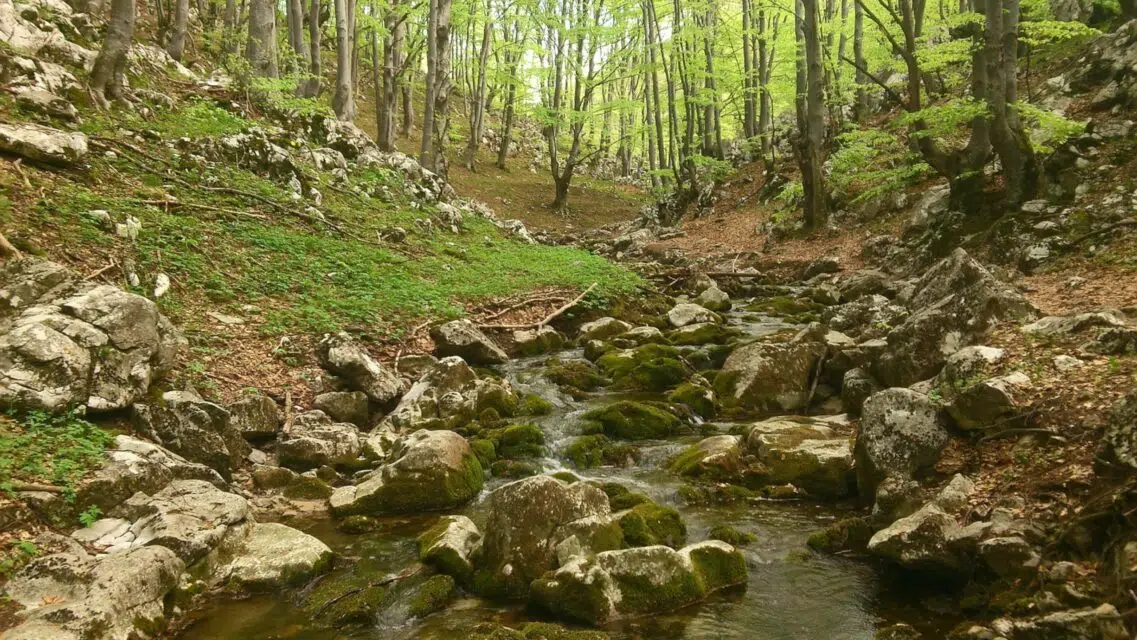
It started as a mistake. The kind that rewrites you.
Five friends, one tired taxi driver, a road that turned from asphalt to dirt without warning. We were supposed to be leaving an event in Plovdiv, chasing sleep and sobriety. Instead, we were chasing a light.
The driver — a man who looked as though he had retired from logic — missed a turn, kept driving, and somehow delivered us into a forest that didn't belong to any map. Then his phone lost signal. Then he decided to take a nap.
You can almost see it, can't you? The absurdity of it all. Five city people, wrapped in Wi-Fi and convenience, suddenly alone with trees and silence and the smell of wet earth. That's where the story should have ended: with us sitting awkwardly in the dark, waiting for the engine to restart. But that's not how forests work. They don't let you go until you've learned something. Or become something.
Somewhere ahead, a flicker of light pulsed like a heartbeat.
Of course, we followed it.
The mason and the pig
"Madness is simply meaning you haven't translated yet."
We found the ghost first. Every forest has one, but this one had a story.
This one was a mason — a Roman craftsman who, legend said, built his own tomb and then couldn't leave it. He was still angry about it. Or sad. It's hard to tell with ghosts. He kept repeating a single phrase: "Why did I eat the cake?"
The cake, we later learned, was poisoned. By his own hand. On purpose or accident, no one knows.
From the underbrush came chickens with glowing eyes, and behind them, a pig holding a cigarette and a cup of coffee. The pig looked bored, the way philosophers do when the world refuses to surprise them. The way Bulgarians look when foreigners ask if communism was "really that bad."
"Wrong tourists," he said, exhaling smoke that smelled like rosemary and regret. And that was it. The clowns that had begun to crawl out of the soil sank back into it. The chickens dispersed. The ghost sighed himself into nothing.
Later, when we stumbled back into the taxi, the driver was still snoring. We shook him awake. He blinked, yawned, and muttered, "Forest bad. Always dream of pigs smoking." Then he started the car.
At first, we laughed. But later — hours, days, months later — the laughter turned into something else. It curdled into recognition, then hardened into understanding. Because the story, ridiculous as it was, stayed with me. It moved into my apartment, made coffee in the morning, looked at me in mirrors. And like most absurd things, it was trying to tell me the truth.
Losing the map
"You don't have to win against confusion; you just have to witness it without fear."
We live in a time obsessed with direction. Our phones tell us where to go, how long it will take, and what the weather will be when we get there. We believe that if we plan enough, we can avoid being lost.
But being lost is essential. Losing the map is how people discover new lands — and new parts of themselves. Columbus was lost. Darwin was lost. Every person who ever mattered got lost first.
That night in the forest wasn't a glitch in the plan; it was the plan we didn't know we needed. It taught me this: when you stumble into confusion, the goal isn't to claw your way back to clarity. It's to recognize yourself in the confusion.
Because the madness is never external. It's not the forest that scares us — it's the echo of our own voice in the dark.
The Bulgarian way of getting lost
In the Bulgarian psyche, there's an unspoken philosophy that mirrors this idea. It's the quiet wisdom you hear in the way people laugh after tragedy, the way they shrug at chaos and pour another coffee. Life, here, isn't a problem to solve. It's a riddle to share.
Bulgarians have learned, across centuries of occupation, disappointment, and resurrection, that the line between sanity and absurdity is very thin. You don't survive it by fighting — you survive it by dancing with it. By recognizing that tragedy and comedy share the same stage, often in the same breath.
When the pipes burst, someone makes a joke.
When history collapses, someone grills peppers and opens a bottle of wine.
When the forest swallows the road, someone lights a cigarette and says, "Eh, we'll find another way. We always do."
It's not denial. It's recognition.
It's the understanding that madness is simply meaning you haven't translated yet.
The forest as a mirror
"Tragedy and comedy share the same stage, often in the same breath."
Every culture has its myths about forests: Dante's dark wood, the Brothers Grimm's haunted glades, even the Bible's wilderness where prophets go to wrestle with doubt. The Bulgarian forest, though, is different. It doesn't punish you for entering. It welcomes you — if you're willing to listen. If you're willing to stop pretending you're not already lost.
The ghost mason is regret — the kind that repeats itself until you finally hear what it's saying. Until you understand that some prisons we build ourselves.
The chickens are the thoughts you chase and can't control. The ones that glow in the dark and scatter when you get close.
The pig, with his cigarette and coffee, is that last shred of humor that refuses to die, no matter how terrifying things get. He's the part of you that stays sane by admitting nothing is.
You meet them all when you lose your way.
And in recognizing them, you begin to recognize yourself.
Designing with chaos
As a writer, I realized something else. The creative process is exactly like that forest. You begin with direction — an idea, a thesis — but halfway through, you get lost. You start doubting your structure, your logic, your point. The words stop making sense. The argument falls apart.
That's the moment most people panic. That's the moment most people quit. But the truth is, the best writing — the kind that surprises you — always comes from that confusion. The forest isn't the obstacle. It's the workshop. It's where the real work happens, in the dark, when you can't see what you're building.
Designers know this instinctively. You sketch, erase, rearrange, until the chaos itself begins to reveal the pattern. The line you drew by accident becomes the spine of the design. The mistake becomes the masterpiece. What looked like failure was just the blueprint learning to breathe.
In life, as in art, order is overrated. Order is what we impose when we're afraid of what we might find in the mess.
Recognition is what matters.
When you see yourself clearly — in the mess, in the madness — you begin to create from truth, not control. You begin to trust the forest.
The logic of absurdity
There's a phrase in Bulgarian: "Да се посмеем, за да не плачем" — let's laugh so we don't cry. It's not cynicism. It's alchemy. It's how sorrow transforms into endurance, how poison becomes medicine if you know the dosage.
That night, the absurd scene of a ghost and a pig in the forest wasn't mocking reality; it was describing it. Holding up a mirror made of smoke and moonlight. Because life itself is ridiculous — fragile and holy at once.
We lose our way. We make choices that poison us, like the mason's cake. We summon our own chaos. And still, we sip our morning coffee, check our messages, keep going.
To fight madness is to misunderstand it. Madness isn't the opposite of sanity; it's sanity's mirror. The forest isn't a curse; it's a teacher who speaks in riddles.
The return
When we finally reached the edge of Plovdiv, the sun was rising. The streets were empty. The city looked both ancient and new, as if the night had pressed some reset button. As if we'd been gone for years, not hours.
I looked out the window and saw an old woman sweeping her stoop with a broken broom, the bristles worn to almost nothing, but still she swept. There was music coming from a nearby apartment — faint, hopeful, unashamedly sentimental. A folk song about loss that somehow sounded like joy.
It hit me then: maybe wisdom isn't about clarity. Maybe it's about rhythm. Bulgarians understand rhythm better than most cultures. Even their sadness keeps time. Their laughter has history. Their ghosts have routines.
To live here is to understand that confusion isn't the end of reason — it's its beginning.
The lesson of the forest
The forest, the ghost, the pig, the laughter — they were all telling the same story.
When you lose your way, when your plans dissolve, when you find yourself in a place that makes no sense — don't run. Stop. Listen. Recognize yourself in the chaos.
Because the chaos is not against you; it is you.
Every absurd moment, every failure, every missed turn — they are the materials of meaning.
This is not a comforting philosophy, but it is a liberating one. It says: you don't have to win against confusion; you just have to witness it without fear.
If you can do that — if you can stand in the dark, smile at the absurdity, and still find the courage to keep walking — you are already home.
And maybe that's what the old driver meant when he said, "Forest bad."
Maybe he wasn't warning us.
Maybe he was smiling at the cosmic joke. Or maybe he was doing both at once, the way Bulgarians do.
Because what he really meant was this:
The forest will take you. It will strip you down. It will show you things you didn't want to see.
But if you let it, if you stop fighting and start listening, it will give you back to yourself.
And you'll be different. You'll be honest.
You'll know what the pig knows: that nothing makes sense, and that's exactly the point.