


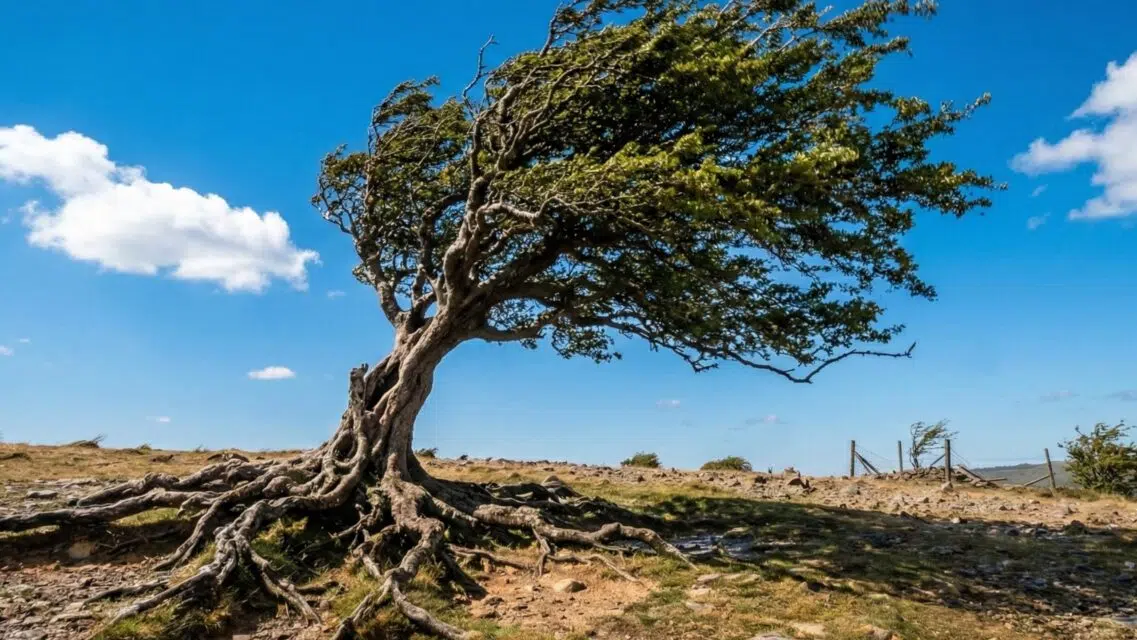
Watch a tree in windstorm. Really watch. The wind comes hard—the kind that snaps rigid things, that topples what won't bend. But the tree doesn't run. The tree doesn't brace and resist until it cracks. The tree stands, rooted deep, while its branches move with what comes. The wind that would destroy rigidity makes the tree stronger—deeper roots, denser wood, wider reach. This is not passivity. This is the most active stance there is.
This is leadership.
Leadership as the tree practices it: standing ground while creating space while converting incoming force into growth. One gesture. One art. Ancient and ready to be remembered.
We call it artlosophy—the unified practice of thinking and making, of philosophy and art working as one. It rests on three movements that, like the tree's response to wind, are not separate actions but a single integrated stance: standing ground, carving space, and converting energy. Together, they form what might be called the art of future politics. Or perhaps more accurately, the art of politics waiting to be practiced again.
First movement: standing ground
The tree teaches its first lesson through rootedness. When storm comes, the tree does not flee. It does not uproot itself and run to calmer ground. Neither does it charge toward the storm as if aggression could defeat weather. It stands. And in standing—rooted, present, aware—it survives what motion could not survive.
The art of standing ground waits to be rediscovered in leadership. Between flight and charge lies the path that calls us forward: the capacity to remain present with what is difficult, to face complexity with awareness and calm, to hold ground that is yours while remaining responsive to what comes.
Standing ground is not the standing of a statue, dead and immobile. It is not the standing of a wall that resists until it cracks. It is the standing of the tree—rooted but flexible, stable but responsive, grounded but growing. The tree absorbs force and converts it. The tree bends but does not break. The tree stands precisely because it knows how to move.
Think of those who've practiced this stance beautifully. Gandhi facing the British Empire—neither fleeing to exile nor charging into violent uprising, but standing in truth so persistently that eventually transformation became inevitable. Mandela enduring twenty-seven years of imprisonment without becoming either broken or bitter, standing on principles while remaining flexible on tactics, emerging with capacity to lead reconciliation. Václav Havel living in truth—neither collaborating nor violently resisting, but creating space through sustained presence where culture could continue, adapt, flourish.
These are not passive figures. They are among the most active leaders history records. But their action emerges from stance, not from mere motion. They stood ground—rooted in principle, present with difficulty, facing what others turned away from. And from that standing came everything else.
This capacity can be cultivated. Not through lecture—one cannot explain presence through words alone. But through practice. Through meditation that trains attention to remain with what is, rather than fleeing to what was or might be. Through martial arts that teach the body what opens new possibilities: that stance precedes technique, that root enables movement, that the one who maintains center amid collision possesses advantage no amount of force can overcome. Through experience that reveals where stance can strengthen, so the work of deepening can begin.
The cultivation takes time. A tree doesn't develop deep roots in a season. Neither does a leader develop capacity for standing ground in weeks or months. It requires seasons of practice, cycles of testing and strengthening, patience with the slow work of growing downward before one can grow upward. And it is possible. The capacity exists in humans as it exists in trees. We need only remember to cultivate it.
Second movement: carving space
The tree teaches its second lesson through form. A tree in forest does not grow every direction equally. It cannot. Other trees occupy space. Light comes from certain angles. Water flows through particular channels. So the tree grows where space exists—reaching toward light, extending roots toward water, developing the form that fits the space available.
But here is what invites our attention: the tree also creates space. Dead branches fall away. Unnecessary mass is shed. The tree sculpts itself through subtraction as much as addition, revealing form by removing what obscures it. This is the sculptor's wisdom applied to living growth.
What if governance could work like sculpture? What if the leader's first question could be not only "what shall we do?" but also "what shall we remove?" Not just what services to add but what restrictions to carve away. Not just what new powers to claim but what old controls to release. The sculptor chips away stone to reveal form beneath. The gardener prunes dead wood to let new growth flourish. The editor cuts words to let meaning breathe. Governance can learn these arts.
Consider a forest—the tree's larger community. No central authority tells each tree where to grow, each root how to spread, each branch when to leaf. Yet the forest functions magnificently—complex, adaptive, resilient beyond measure. Why? Because the forest operates within boundaries, not instructions. Gravity constrains. Water flows where geology permits. Sunlight determines what thrives in shade or clearing. Within these physical limits, infinite variation emerges. Ten thousand species find their niches. The system self-organizes not because someone plans it but because clear boundaries create space for emergence.
Or consider jazz—that most organized of improvisations. The musicians do not play from detailed scores specifying every note. Yet the music is not chaos. The musicians agree on key, tempo, chord structure—the boundaries. Within those constraints, they improvise. They listen. They respond. The music that emerges is more alive, more adaptive, more surprising than any fully composed piece could be. The constraints do not limit creativity; they enable it by giving it shape, direction, relationship.
Governance can learn from forests and jazz. Define clearly what harms cannot be permitted—violence, coercion, deception, destruction of shared resources. Establish these boundaries with absolute clarity and honor them absolutely. But within those bounds? Let communities discover their own solutions. Let individuals experiment with their own lives. Let cities explore their methods. Let regions adapt to their geographies. Define the boundaries; invite the emergence within them.
This asks for courage because it asks for trust. Trust that within proper boundaries, people will create solutions more elegant than any central design could specify. Trust that emergence carries wisdom, that evolution performs beautifully, that the distributed intelligence of millions making local decisions can surpass the concentrated intelligence of dozens making central ones.
In Koprivshtitsa, Bulgaria, the houses stood through centuries not by fighting but by being so beautiful, so perfectly themselves, that they became impossible to ignore. Architecture as cultural practice. Form as identity. This is the sculptor's art applied to continuity: reveal what matters by honoring its essence, create identity through clarity of form, persist through beauty that speaks for itself.
The carving can be learned. Through studying systems that work by defining space rather than filling it. Through attempting actual simplification in real communities with real possibilities. Through discovering that choosing the right things to honor is both harder and more valuable than adding new things. Through developing the sculptor's eye that sees form waiting to emerge, that distinguishes essential from accumulated.
Third movement: converting energy
The tree teaches its third lesson through conversion. Wind carries energy—immense, constant, sometimes powerful force. The tree does not waste this energy or merely endure it. The tree converts it. Wind that bends branches stimulates growth. Stress that flexes the trunk makes wood denser, stronger. Force that tests roots drives them deeper. The tree takes incoming energy and transforms it into exactly what makes the tree more capable of working with future energy.
This is conversion—transforming potential into actual, force into growth, challenge into capacity.
Think of a river. Enormous energy flows in that water, constant force moving mass. The energy accomplishes work when harnessed through mechanisms: waterwheels that convert flow into rotation, turbines that convert pressure into electricity, irrigation systems that convert volume into agricultural abundance. With conversion machinery, the river's power becomes purposeful, directed, creative.
Democratic systems hold enormous untapped potential for conversion. Energy flows everywhere—millions who care, who organize, who march, who vote, who attend meetings, who invest themselves in political participation. Enormous energy, constantly renewed. This energy waits for better conversion mechanisms.
We can build such mechanisms. Real conversion means that when people invest energy, that energy produces visible effects on reality. It means feedback loops clear enough that people see the relationship between their effort and outcomes. It means decision-making distributed at scales where participation is both possible and consequential.
Porto Alegre, Brazil pioneered participatory budgeting in the late 1980s, allowing residents to directly decide allocation of municipal budget. The connection became direct—communities discussed priorities, voted on spending, and saw results in their neighborhoods. Energy converted to power converted to reality. Even those whose preferred projects weren't selected that year stayed engaged because they saw the process convert energy honestly, and they participated again.
Ireland's Citizens' Assembly used sortition—random selection like jury duty—to address one of the country's most contentious issues. In 2016-2018, 99 randomly selected citizens deliberated on abortion law, heard from experts and advocates across all perspectives, and produced recommendations that helped break decades of political deadlock. Random selection brought in genuine diversity of perspective and enabled honest deliberation that electoral politics couldn't achieve.
Taiwan's digital democracy experiments, led by Digital Minister Audrey Tang, enable millions to participate in policy development through platforms like vTaiwan and Polis. These tools aggregate input, identify areas of consensus even amid disagreement, and produce decisions government actually implements. The technology enables scale while maintaining meaningful connection between participation and outcome. People participate because participation produces results.
The pattern invites us: reduce distance between effort and effect. Make conversion machinery visible, responsive, fair. Let people see that their energy matters, that it transforms into something real. This isn't about everyone agreeing—it's about making participation meaningful. Even people who support different solutions stay engaged when they see the process converts energy honestly.
The conversion capacity can be developed. Through studying communities where energy converts well and understanding what mechanisms enable it. Through building and testing actual conversion systems in real contexts with real participants. Through discovering what good design looks like. Through learning when to use elections versus sortition versus direct democracy versus liquid democracy, matching mechanism to purpose and context.
The integration: three movements as one
But here is where the tree's wisdom becomes deepest: these three movements are not separate. The tree doesn't stand, then carve, then convert in sequence. The tree does all three simultaneously, constantly, as one integrated response to conditions.
The roots that provide standing also carve through soil, creating channels for water. The branches that bend in wind also shed what no longer serves, revealing form. The energy conversion that makes wood denser also deepens roots that improve standing. Standing enables wise carving—you must be present with complexity before knowing what to honor. Carving creates space for converting—energy flows better through clear systems. Converting produces feedback that informs standing and carving—you learn what works and adapt accordingly.
This is integration. Not sequence but simultaneity. Not skills applied separately but capacities that have fused into unified practice. This is what we mean by artlosophy—thinking and making as one gesture, philosophy and art unified, the three movements working as the tree's single response to wind.
This is the art. This is what the tree does naturally. This is what humans can learn to do through deliberate cultivation.
Learning the art
How does one learn to be a tree in political wind? Not through lecture alone. Integration is embodied, practical, demonstrated through action and practice. It emerges through experience under conditions complex enough to invite it.
One approach to cultivating these capacities might unfold over extended time—years rather than months—building depth through progression:
Beginning with roots: learning to stand ground through practices that train presence and awareness. Meditation that develops attention. Physical disciplines that teach embodied stability. Study of those who demonstrated this capacity beautifully. The work of developing ability to remain present with difficulty, to face complexity without flinching, to hold ground while staying responsive.
Then exploring form: learning to carve space through studying systems that work by honoring boundaries rather than dictating every detail. Partnering with communities to explore what could be simplified while maintaining what truly matters. Developing the eye that sees form waiting to emerge, that distinguishes essential from merely accumulated.
Then building channels: learning to convert energy through understanding how civic participation actually flows and what makes conversion work. Studying communities where mechanisms convert energy beautifully. Building and testing actual tools with real communities making real decisions. Discovering what design enables genuine conversion.
Finally integrating: testing whether the three capacities can work as one through engagement with real complexity, real opportunity, real responsibility. Discovering what integration feels like when standing and carving and converting must happen simultaneously. Producing work that demonstrates unified practice.
The formation would be demanding—requiring commitment to depth over breadth, patience with slow growth, willingness to practice rather than merely study. But it would be possible. The capacity exists. The art can be learned.
When leadership is practiced this way—not in theory but in reality—what becomes possible?
Climate work led by those who can stand ground with complexity, who can identify what structures to honor and what to release to enable transition, who can convert civic energy into actual governance of transformation. Participatory planning of adaptation. Inclusive decisions about change. Energy channeled into purposeful action.
Economic work led by those who can remain present with multiple perspectives, who can design systems that honor essential protections while creating space for innovation, who can convert worker and community knowledge into shared governance. Not central control, but distributed intelligence channeled through well-designed mechanisms.
Justice work led by those who can stand with historical complexity and present passion, who can design systems that honor both safety and healing, who can convert community energy into actual shared power over decisions about safety, schools, development, resources.
Local governance led by those who can stand ground amid competing pressures, who can honor what communities value while creating space for adaptation, who can convert resident energy into ongoing democratic participation in shaping neighborhood futures.
This is not fantasy. Every element exists in practice somewhere already. Leaders demonstrate these capacities—sometimes, in places, recognizably. Communities govern themselves beautifully when given genuine power within clear boundaries. The examples exist. They invite us to learn from them, to practice what they demonstrate, to make such leadership more common.
Moving forward while staying rooted
There is a small nation in Europe that demonstrates this wisdom beautifully. Bulgaria's history—simplified but instructive—shows a pattern: centuries under Ottoman rule, occupation during World War II, decades within the Soviet sphere of influence, then the pressures of European integration. Through each wave of outside power, Bulgarian culture persisted not by rigid resistance but by adaptive preservation.
When outside powers came, Bulgarians found ways to maintain identity within changing circumstances. Language survived in mountain monasteries. Culture transmitted through songs grandmothers taught. Architecture remained distinctively beautiful. The pattern repeats: honor what matters most deeply, adapt what can change, survive by being flexible enough to bend without abandoning what makes you yourself.
This is artlosophical practice demonstrated through cultural survival—knowing what to hold absolutely and where to move with grace, what to protect and where flexibility serves better than rigidity. Different cultures practice versions of this wisdom. Indigenous peoples maintaining identity through adaptation. Communities preserving tradition while engaging change. The wisdom repeats: honor deep roots, create space to move, convert challenges into growth.
This wisdom can be shared and practiced. Not easily—it invites sustained formation, cycles of practice and discovery. Not with everyone—different people have different callings. But with those who sense that politics can be practiced more artfully, that leadership can be more integrated, that democracy can convert energy more beautifully.
To those who want to learn: the art exists. The capacity can be cultivated. The tree shows us how.
The wind is always coming. That is the nature of political life—change, complexity, challenge, opportunity. The question is not whether wind comes but how we respond when it does.
We can learn from the tree. Can stand ground while bending. Can carve form while growing. Can convert force into depth. Can practice politics as art—the unified gesture of thinking and making, of standing and carving and converting, of philosophy embodied and form achieved and energy transformed.
This is artlosophy. This is the invitation. The wind comes. What becomes possible?
The roots deepen through practice. The form reveals through attention. The energy converts through care. The integration emerges through time.
The art is ancient. We can learn it again. The tree teaches still, if we watch, if we practice, if we stand long enough to see.
The future arrives whether we shape it or not. The question becomes: will we shape it with wisdom born from standing ground, with beauty born from carving well, with power born from converting energy into purposeful creation?
The tree knows the answer. And what trees know, humans can learn.
The practice begins with watching. With presence. With standing still enough to see.
Then the carving. Then the converting. Then the integration of all three as one.
Then something becomes possible. Something that waits to be remembered.
Politics as art. Leadership as practice. Democracy as the living system it's always meant to be.
The tree in wind. The art of future politics. The way forward that honors deep roots.
The practice waits. The tree teaches. We can begin.