



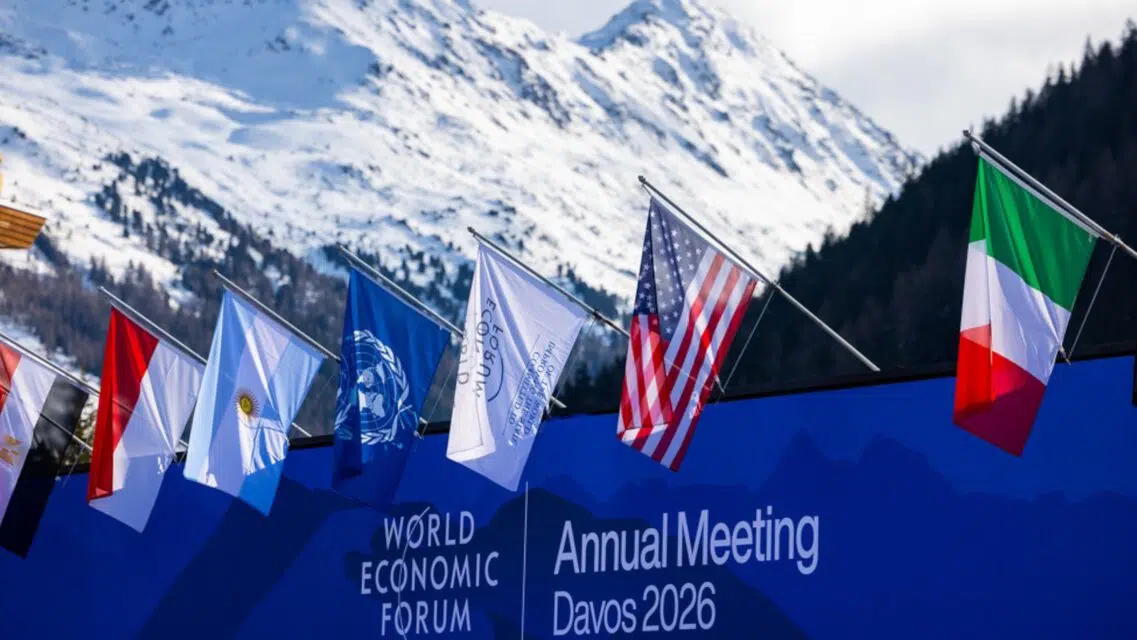
While Sauron’s eye was fixed firmly on Davos - swiveling slowly over snowbanks, glass facades, and men named Klaus wearing identical scarves - it is worth remembering a different story about perspective, ambition, and the dangers of elevation without understanding.
In 1982, a man named Larry Walters, a truck driver from California, decided that the world looked insufficiently interesting from ground level. Larry was not a pilot. He did not own a plane. What he did own was a lawn chair, 42 helium-filled weather balloons, a pellet gun, a six-pack of beer, and several sandwiches wrapped with the confidence of a man who had never been asked a follow-up question.
Larry’s plan was modest. He intended to float a few feet above his backyard, enjoy the view, maybe wave at a neighbor, and come back down before anything complicated happened. Instead, the balloons worked exceptionally well. Larry ascended rapidly to 16,000 feet, drifting directly into controlled airspace, calmly seated, wearing sunglasses, and slowly realizing that ambition does not come with brakes.
Commercial pilots radioed in sightings of a man in a lawn chair hovering outside their windows. The FAA had what can only be described as a bureaucratic awakening. After 45 minutes, Larry fired his pellet gun at the balloons one by one, descended erratically, tangled himself in power lines, and caused a local blackout.
When asked why he did it, Larry Walters replied:
“A man can’t just sit around.”
Larry did not intend to gain perspective. He achieved it accidentally. And that is precisely why the story matters.
Because Davos 2026 was the exact opposite.
Davos had altitude, money, power, and visibility. What it did not have was perspective. It had height without distance, urgency without clarity, and a view so close to itself that it mistook motion for direction. If Larry Walters packed sandwiches for a situation that required parachutes, Davos packed parachutes for a situation it refused to admit was happening at all.
An Emergency Meeting Was Held. Everyone Agreed to Use a Softer Voice.
Davos this year looked exactly as it always does: snow arranged with Swiss precision, glass buildings filled with people wearing identical expressions of calibrated concern, and enough security badges to wallpaper a mid-sized Balkan ministry. The difference was not visual. It was tonal.
Something had shifted.
The West had arrived not as a confident empire discussing the future, but as an anxious middle manager discovering that the intern has quietly learned how to run the company - and is no longer asking permission.
January 2026 will be remembered as the moment Silicon Valley stopped smiling politely and started sweating through its Patagonia vests. Not loudly. That would be unseemly. More in the way of people lowering their voices, leaning closer, and saying phrases like “six months” as if they were discussing a terminal diagnosis rather than artificial intelligence.
The official theme of the World Economic Forum was, as always, optimistic nonsense. The unofficial theme was panic, rendered in tasteful beige.
For years, the West had told itself a comforting story. China, it said, could only copy. China, it said, required endless hardware to compete. Generative AI, the theory went, was a brute-force game: whoever stacked the most GPUs would inevitably win.
So Washington turned off the Nvidia tap, congratulated itself, and waited for gravity to do the rest.
Instead, gravity appears to have been optional.
China did not collapse. It reorganized. It rewrote. It optimized. It did the unthinkable: it treated scarcity not as a tragedy but as an engineering constraint. Which is deeply offensive to people who just spent $40 billion on server farms.
Demis Hassabis of DeepMind, speaking with the calm demeanor of a man explaining a fire to a library, summarized the situation without drama. Chinese AI labs, he said, are about six months behind the frontier. Not years. Not decades. Six months.
In technology time, that is the distance between two committee meetings.
This assessment passed through Davos like a cold draft. Executives nodded gravely. Some pretended they already knew this. Others pretended to be very interested in their phones.
The trauma of the “DeepSeek shock” of 2025 still lingered in the corridors - the moment when a Chinese model demonstrated world-class performance without the kind of compute budgets that normally require a small country’s power grid. Western AI had grown accustomed to a theology known as Scaling Laws: more data, more chips, more power, more miracles.
The Chinese, inconveniently, had started asking whether activating the entire brain to answer “what time is it” was perhaps inefficient.
Mixture-of-Experts architectures - models that wake only the relevant parts of themselves - became the quiet star of the show. Not flashy. Not poetic. Just effective. Like a civil servant who never loses your file.
Meanwhile, the battle over chips became openly theological. Dario Amodei of Anthropic warned that selling advanced computing power to China was equivalent to handing nuclear weapons to a regime that does not ask permission. The phrase “an entire nation of geniuses” was deployed, which is impressive considering it was uttered next to a croissant.
Sam Altman attempted to occupy the middle ground, which in Davos is approximately the size of Liechtenstein. This, he argued, was not a bubble. This was infrastructure. The largest infrastructure project in human history. Power plants, server farms, data centers - all of it urgent, all of it necessary. Profitability could wait. National security could not.
At this point, Pfizer’s CEO helpfully wandered onto the same stage and provided what might be called accidental honesty. AI, he explained, would allow humanity to create medicines we had never even dreamed of. The real question, therefore, was who would deliver this miracle.
The answer, he said with refreshing candor, was the United States and China - with China probably surpassing the U.S. in a year or two.
This was not framed as a threat. It was not framed as a warning. It was simply a man from Big Pharma acknowledging that the future of medicine would be decided by geopolitics, not ethics, and certainly not by press releases. Somewhere in the room, a lawyer quietly canceled lunch.
Elon Musk, of course, did not cancel lunch. He arrived late, said very little about regulation, and unveiled Colossus 2 - a computing cluster consuming power at gigawatt scale. This is the point at which Switzerland briefly considered introducing a noise ordinance for electricity.
Musk mocked safety concerns, mocked competitors, and implied that speed itself was the only remaining moral category. For him, the solution to China was not policy. It was bigger machines.
Jeff Bezos, speaking elsewhere, offered a metaphor instead. The AI boom, he said, resembled the early Industrial Revolution, when every factory built its own power station. Waste was inevitable. Chaos was guaranteed. Some would burn cash. Some would survive.
This was not a collapse. It was sorting.
And still, Davos did not zoom out.
Meanwhile, Britain Solves the Future by Grounding the Internet
While Davos debated planetary infrastructure, Britain addressed the crisis closer to home. The UK House of Lords voted to ban VPN usage for young people. VPNs, apparently, had become too powerful to be trusted in adolescent hands. Only adults would be permitted to obscure their digital location while browsing a network increasingly powered by artificial intelligence systems they neither control nor understand.
In the same breath, Britain advanced a social media ban for under-16s. This was framed as protection. It had the color and texture of a damp regulation, faintly smelling of carpeted committee rooms. The internet, having failed to behave, was grounded.
No further comment was offered. None was required.
Across the Atlantic, geopolitics abandoned subtlety altogether. President Donald Trump announced that if Canada dared to make any deal with China, it would face a 100% tariff on every single Canadian product entering the United States.
This was not diplomacy. It was a spell, cast entirely in capital letters.
Canada, in this sketch, played the role of the bewildered neighbor who only wanted to sell lumber and now finds itself in a Michael Bay sequel. Whether the tariff applied to maple syrup, hockey sticks, or the concept of politeness itself was left unclear.
Meanwhile, space continued to be profoundly unbothered. NASA confirmed that asteroid 2025 PN7 has been a “quasi-moon” for approximately sixty years. It shares Earth’s orbit, loiters politely, and will continue doing so until 2083. It is small, invisible without telescopes, and poses no threat whatsoever.
In other words, it is behaving far better than most governments.
Europe Responds with a Platform, a Policy, and a Deep Sigh
Back on Earth, Europe decided to solve the social media problem by inventing a new one. X, we were informed, is dead. W is the future - a new social network built according to European rules, hosted on European servers, and managed by people whose professional lives have been dedicated to preventing excitement.
The CEO, Anna Zeiter, formerly eBay’s Chief Privacy Officer, explained that there is an urgent need for a platform developed, governed, and hosted in Europe. Investors from the climate-protection scene nodded enthusiastically. Regulation, at last, had found its aesthetic.
The platform’s primary appeal appears to be that it will never surprise anyone.
This is, of course, precisely what many users have always wanted: fewer voices, more compliance, and a reassuring sense that every post has been gently reviewed by someone who owns a ring binder.
Britain, not content with regulating the future, also attempted to rewrite the past. Keir Starmer’s Chagos project collapsed not because of new information, but because the United States finally looked at it. Once Washington raised the inconvenient matter of a 1966 treaty, the structure fell apart like a temporary exhibition.
For months, urgency had been the argument. International law. Security. Inevitability. None of these survived contact with reality. There was no deadline. No threat. No compulsion. The urgency was political, and it evaporated the moment someone outside the room asked a basic question.
Elsewhere, history quietly ended. Sony sold the majority of its television business to TCL. For younger generations, this is meaningless. For others, it is like discovering that a cathedral has been converted into a logistics hub. There was a time when seeing a Sony TV meant quality, authority, and a faint hum of technological confidence.
That era has now been outsourced.
Japan, characteristically, did not make a fuss. Prime Minister Takaichi dissolved parliament and called an early election. The announcement was efficient, untheatrical, and deeply unsettling to anyone who prefers chaos with a press strategy.
China, meanwhile, continued doing things. Many schools now use AI systems to grade homework - scanning, annotating, and identifying weak points. Teachers save time. Students receive targeted help. The machines are not replacing educators; they are doing the boring parts competently, which is arguably worse.
Chinese AI is not chasing poetry or philosophy. It is embedding itself into factories, vehicles, logistics systems, and city management. BYD and Xiaomi are turning cars into rolling computers. The goal is not AGI. The goal is utility. This distinction is apparently important, though it ruins several PowerPoint decks.
On the hardware front, Huawei’s Ascend chips remain inferior to Nvidia’s best - but they exist, they scale, and they connect in vast clusters using optical networks clever enough to compensate for individual weakness. Tens of thousands of chips working together, quietly, relentlessly. There are also rumors of gray markets, smuggled hardware, dismantled consumer devices. None of this is confirmed. None of it is surprising.
Data, of course, remains China’s strongest card. While Western companies drown in lawsuits and GDPR compliance, China treats data as a national resource. WeChat alone provides a high-resolution map of human behavior that regulators elsewhere can only dream of - or fear.
At Davos, the realization never fully landed. The West is still measuring the race by counting chips, while China is building a different track entirely - cheap, efficient, ubiquitous AI embedded into physical products, flooding emerging markets, reshaping economies without asking permission.
The six-month gap everyone is panicking about may be real. It may also be irrelevant.
Because the danger is not that China will catch up.
The danger is that the West, seated comfortably at altitude, will mistake height for vision - and only notice the ground when the balloons begin to pop.