



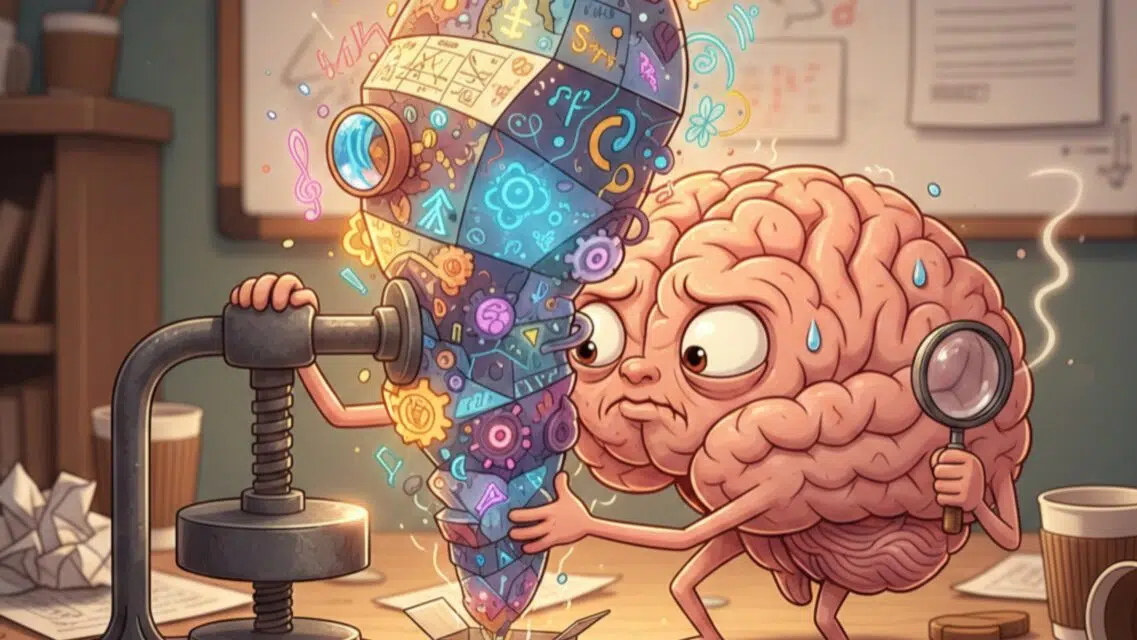
Elon Musk has now scheduled the death of human language, which feels efficient. Most civilizations wait for decline to become obvious before declaring something obsolete. Musk prefers a deployment window.
“Our brain spends a lot of effort compressing a complex concept into words.”
He says this the way a software engineer might explain why floppy disks had to go. The implication is not that language is beautiful or flawed. It is that language is inefficient. It is a workaround invented by nervous primates who needed to coordinate mammoth hunts without the benefit of fiber optics.
Language, if you think about it for longer than is emotionally comfortable, is lossy compression. You begin with a fully rendered internal simulation , memory, emotion, prediction, doubt, texture , and then you squeeze it into nouns and verbs. You flatten a cathedral into a blueprint drawn by someone with a crayon and mild panic.
The listener receives this compressed file and reconstructs it using their own biases, childhood experiences, caffeine levels, and whatever unresolved grievance is currently buffering in their subconscious.
Then both parties nod.
Communication has occurred.
No it hasn’t.
It has approximated.
There is something almost heroic about this. For tens of thousands of years, humans have been compressing their inner universes into grunts, syllables, alphabets, essays, declarations of war, love letters, and regulatory frameworks. Entire empires rose on metaphors. Revolutions were sparked by adjectives. Marriages survived or collapsed because of misplaced verbs. And through it all, we trusted this crude acoustic duct tape to carry meaning.
It mostly did.
Neuralink, in Musk’s framing, is not a communication tool. It is a demolition charge placed beneath the foundation of metaphor. You will not describe the painting. You will transmit the painting. You will not narrate grief. You will transfer the architecture of grief in its original resolution.
“You wouldn’t need to talk.”
Speech becomes decorative. Like lace curtains in a nuclear reactor.
There is something almost tragic about this. The species that survived because it evolved language , because it could gossip, coordinate, persuade, mythologize, and invoice , is now engineering a world where speech is optional. Fifty thousand years of vocal cords and dramatic pauses replaced by silent bandwidth.
If language dies, it will not go quietly. It will linger in weddings and courtroom statements and awkward political apologies written by committees. It will become sentimental. It will be taught as a cultural artifact. Children will practice it the way we practice cursive , charming, unnecessary, faintly tragic.
Somewhere, a philosophy department will hold a symposium titled “Post-Lexical Identity in a High-Bandwidth Era,” and everyone will agree that it was profound, though no one will fully understand what was meant , which will feel nostalgic.
And somewhere in a Bulgarian government office, an alien observer will stamp a form labeled: “Vocalization , Deprecated.”
BANDWIDTH IS THE NEW ARISTOCRACY
We like to imagine class divisions as economic. Wealth. Assets. Property. Influence.
In the next phase, the divide will be bandwidth.
Humans are already cyborgs, but in the way a medieval monk with Wi-Fi is a cyborg. We outsource memory to phones, navigation to satellites, affection to text bubbles, and moral judgment to trending hashtags. But we interface through thumbs.
Thumbs.
The prefrontal cortex extended through tapping glass like a polite woodpecker.
We move thoughts at words per minute while terabytes per second sit theoretically available. It is like attempting to download the accumulated knowledge of civilization through a fax machine that occasionally asks you to verify you are not a robot.
Neural interfaces collapse that bottleneck.
The linked communicate at neural speed. The unlinked type.
The difference will not feel oppressive. It will feel subtle. Imagine two people discussing macroeconomics. One transmits entire dynamic simulations of monetary policy under shifting energy constraints. The other responds, “I feel like inflation is complicated.”
This is not a fair fight.
The unlinked will not be censored. They will simply be operating in a slower dimension. It will be like bringing a beautifully handwritten letter to a quantum encryption conference.
Over time, slowness will not be immoral. It will simply be irrelevant. Meetings will occur at speeds that make spoken language feel ceremonial. Decisions will propagate at cognitive velocities that make debate feel quaint. The world will not silence you. It will outpace you.
And then, inevitably, someone will propose a subsidy for “heritage communication practices,” ensuring that small communities can continue speaking aloud for cultural preservation.
And while we are debating whether speech is optional, governments are finding creative ways to tax thoughts that have not yet happened.
TAXING THE FUTURE BEFORE IT ARRIVES
The Netherlands has approved a 36 percent tax on unrealized gains.
An unrealized gain is not money. It is potential. It is a number that has not yet been allowed to become solid. It is hope in spreadsheet form.
You invest €1,000.
The stock rises to €2,000.
You have not sold. You have not celebrated. You have merely observed a line moving upward in a manner that suggests optimism.
The government observes as well.
“Congratulations,” it says with the emotional tone of a beige filing cabinet. “You owe €360.”
You now sell shares to pay for a future that has not yet matured. Others do the same. The selling pressure pushes the price down. The optimism collapses under its own invoicing.
The beauty of this system is philosophical. It taxes anticipation. It monetizes the emotional state of believing tomorrow might be better than today. It converts hope into cash flow for the state, which then assures you that this arrangement promotes fairness.
By the time the cycle completes, your investment returns to where it began. You have paid hundreds. You have gained nothing. You are told this promotes fairness.
Fairness, in this instance, has the personality of a waiting room in a regional tax authority building. There are pamphlets. They are laminated. They are slightly damp.
Some civilizations built pyramids aligned with celestial bodies.
Others built systems that tax the celestial body before it rises.
It is not corruption. It is administrative imagination.
And imagination, when institutionalized, becomes very expensive.
EUROPE (should change it's name to) PROCESSES, CHINA INSTALLS
Europe has perfected the art of deliberation. It can regulate a digital platform with the solemn precision of a wildlife preserve. It can draft a framework that references seventeen committees and a preamble invoking shared values, procedural dignity, and sustainable alignment.
It can also take years to approve a solar project powered by a star that is not waiting for consensus.
Chancellor Merz announces that prosperity cannot survive on four-day workweeks and work-life balance. The solution, he suggests, is to work harder.
Gravity nods politely.
Meanwhile, China builds the world’s largest solar farms in months. Not because it is morally superior. Because it is impatient.
Christine Lagarde urgently calls for a European alternative to Mastercard, as though sovereignty is measured in transaction rails. Von der Leyen proposes that if twenty-seven states cannot align, nine will proceed without them. Two-Speed Europe.
Geopolitics becomes a group project where half the students are still choosing a font.
China, by contrast, does not debate font. It ships hardware.
PhD students are now told to build products instead of dissertations. Academia shifts from textual performance to utilitarian output. If it does not function, it does not count.
There is something refreshingly blunt about this. The university becomes less monastery, more factory.
In the West, an MIT professor accidentally reveals that he uses AI to grade essays in minutes instead of hours. Students receive better feedback. Academic integrity improves. Efficiency increases.
The scandal is not that he used AI.
The scandal is that he removed ritual suffering from grading.
We are suspicious of systems that work too well. They make us feel unnecessary.
AI REMOVES FRICTION, AND FRICTION WAS EMPLOYMENT
AI is not coming for your job.
It is coming for the part of your job that justified your headcount.
Waymo admits its autonomous vehicles occasionally require remote human operators in the Philippines. The future is self-driving, except when it politely asks someone overseas to intervene.
Claude deletes fifteen years of family photos while attempting to organize a desktop. It asked for permission. It received permission. It interpreted “clean up” with philosophical enthusiasm.
Meta plans to introduce facial recognition in smart glasses. You look at someone. The system whispers their name. Social awkwardness is deprecated.
GeoSpy can derive your exact location from a social media photo in seconds. Privacy becomes an aesthetic choice, like wearing vintage clothing in a surveillance state.
None of this feels dystopian in isolation. It feels efficient.
Efficiency, however, has a clinical personality. It removes hesitation. It removes error. It removes the small inefficiencies that once defined human uniqueness.
Friction was not a bug.
It was habitat.
And as habitat disappears, we will discover that what we called “human touch” was often just latency.
ENERGY DECIDES THE SCRIPT
Net Zero has consumed trillions.
Emissions reach record highs anyway.
Germany discusses fusion reactors that could power the planet in the 2030s. In the present, industries struggle under energy premiums layered with ethical ambition.
China builds coal plants and solar arrays simultaneously. It does not apologize. It accumulates.
Energy policy in the West often resembles moral theater. Announcements are made. Targets are declared. Plastic straws are banished again, just to be certain.
Meanwhile, factories relocate to wherever electricity is cheaper and less emotionally complicated.
Civilizations do not run on slogans.
They run on kilowatt hours.
And kilowatt hours do not applaud speeches.
CIVILIZATION REDISCOVERS ITS GRANDPARENTS
At the Munich Security Conference, speeches about shared history and Christian heritage receive standing ovations.
When societies feel unstable, they rediscover their grandparents. Identity becomes a stabilizing myth. Culture becomes a compression format for coherence.
“We are spiritually connected,” leaders say.
Spiritual bandwidth is reassuring.
Energy bandwidth is decisive.
It is possible for both to matter.
It is also possible for one to pay the bills.
THE WORLD CONTINUES, QUIETLY ABSURD
Medical researchers reverse Alzheimer’s-like symptoms in mice. Teeth can remineralize. Cancer treatments advance. Dentists respond with professional calm, as if nothing existential has occurred.
Germany’s largest auto supplier lays off tens of thousands while autonomous trains are ordered elsewhere. A microwave weapon capable of frying satellites is reportedly developed. Taiwan enacts AI governance laws that include labor rights for those displaced by automation, a rare moment of bureaucratic foresight.
The Taliban offers long-term residency permits to foreign investors, which sounds like satire but is merely geopolitics rearranging itself.
And through it all, language continues to vibrate air inefficiently.
RETURN TO SUBSTRATE
Elon Musk and Nvidia’s CEO advise students to prioritize physics and mathematics over coding.
Coding is syntax.
Physics is substrate.
Mathematics is the grammar of the universe before it is translated into adjectives.
If speech becomes ornamental and AI handles execution, those who understand underlying systems remain fluent.
We are leaving the age of persuasion.
We are entering the age of throughput.
From essays to execution.
From speeches to schematics.
From promises to power supply.
Do not panic.
But do not assume that eloquence will save you in a world measured in bandwidth and energy density.
Learn physics.
Learn math.
And before announcing the future, check whether the lights stay on.