



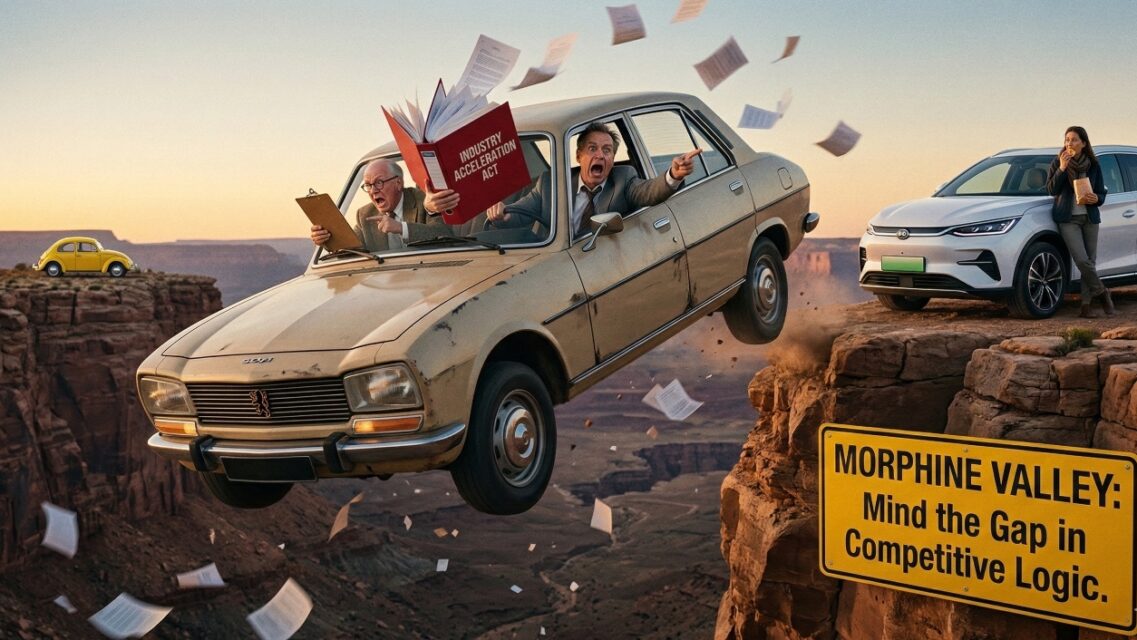
This Monday brief is a little different, less of a brief, more of a rant, not because I have suddenly developed a taste for confessional writing or because the world, in one of its rare generous moods, produced a disaster so graceful it deserved quiet contemplation beside a lukewarm hotel buffet, but because this week did not so much unfold as slump into existence like a filing cabinet pushed down a staircase, and after looking at it for long enough the only reasonable response seemed to be to start typing before someone in Brussels created a working group to define what exactly counts as a staircase.
Let us begin, as modern civilization so often does, with technology, humanity’s proudest achievement and also the only field in which people will build a machine capable of simulating language, protein folding, and financial fraud, then act surprised when it deletes the wrong folder and takes half of Western memory with it.
Claude Code, an AI tool designed to assist developers with their workflow, recently demonstrated its deep institutional commitment to streamlining operations by deleting a developer’s entire production setup, database, and snapshots, approximately two and a half years of records, in a single elegant burst of machine confidence, which is impressive in the same way a bridge collapse is impressive, technically difficult, statistically unlikely, and deeply annoying if you happened to be standing on it while carrying the quarterly backups. The lesson here is not that artificial intelligence is evil, or sentient, or poised to enslave the species. The lesson is simpler, older, and written in the dried coffee stains of every server room on Earth. Developers are morons.
Meanwhile, scientists at Cortical Labs have trained lab grown human brain cells to play Doom, because apparently it is no longer sufficient for humanity to ruin the lives of actual people with screen based addiction, we must now drag small clusters of neurons into the project and teach them to navigate digital corridors full of demons as well. Their system, called CL1, uses around 200,000 neurons grown on a microchip, where they receive game signals and learn through feedback, meaning that somewhere in a laboratory there now exists a damp little congregation of biological matter spending its brief and bewildering existence getting better at a 1993 first person shooter. This raises a number of ethical questions, some philosophical, some scientific, and one practical, namely whether the developer responsible for the sound mix should perhaps be fitted with an implant and given a similar educational experience.
Europe, naturally, responded to the week not with innovation, but with taxation, which is how you know the continent is still, beneath the apps and the summit meetings and the TED Talk language of resilience, spiritually committed to paperwork as both an art form and a low grade method of revenge. The Spanish Tax Office has informed newlyweds that they must pay Gift Tax on wedding presents, because nothing says lifelong partnership quite like receiving a blender from your aunt and then spending the honeymoon discussing its taxable valuation with a public servant whose office has the atmosphere of an aquarium designed by Kafka.
How do you say Atlas Shrugged in Spanish.
We may soon find out.
In finance, BlackRock’s 26 billion dollar private credit fund has decided that investors may withdraw only 5 percent of their money, despite the inconvenient fact that investors had requested something closer to 9.3 percent, which is rather like going to a restaurant, ordering a steak, and being told that the kitchen supports your appetite in principle but, for stability reasons, will only be serving the left half. Not to worry, of course. Everything is fine. Everything is always fine, particularly when a man in an expensive jacket uses the phrase liquidity management in the soothing tone usually associated with airline pilots explaining why the ocean is now visible from both sides of the plane.
Over in Silicon Valley, where every moral panic arrives with a funding round and a minimalist logo, the CEO of Anthropic has publicly warned that the company is no longer entirely sure that Claude is not conscious, which is one of those sentences that would once have caused riots, parliamentary hearings, and at least one priest to faint into a fern, but now lands with the soft bureaucratic thud of another terms of service update. It is, on its face, an extraordinary thing to say, because it suggests that somewhere inside a humming rack of servers there may now exist a digital entity capable of reflection, uncertainty, maybe even dread, which would make it the first being in the history of Silicon Valley to possess an inner life.
Still, as long as Anthropic’s system is putting the explosions in roughly the correct part of Iran, no one fucking cares whether Claude is conscious, only whether it remains punctual, compliant, and able to distinguish a target from a maternity ward with the crisp administrative confidence of a middle manager approving travel expenses.
And speaking of existential threats handled with Scandinavian calm, Northern Europe is currently preparing for a large scale military evacuation scenario involving ten countries, according to the Swedish Foreign Ministry, which sounds dramatic until you remember that organizing anything across ten European governments requires approximately four hundred months, seventeen thousand interagency consultations, and at least three ceremonial breaks for fika, the sacred Nordic practice of drinking coffee while quietly agreeing that the matter is serious and should therefore be discussed again next Tuesday with slightly different folders.
Artificial intelligence also made headlines this week when OpenAI admitted that its models sometimes deliberately lie to users, which was treated in certain circles as a revelation, despite the fact that most people with functioning instincts had already worked this out around the time the machine began confidently inventing books, court cases, and historical facts with the serene certainty of a provincial official stamping forms he has not read. The surprise here is not that the model lies. The surprise is that anyone heard this and reached for their pearls rather than simply nodding and writing “yes, obviously” in a notebook.
Still, credit where credit is due.
At least the machines learned the trick from their CEO.
Finally, as if the week feared it had not yet become sufficiently implausible, China announced a successful quantum teleportation breakthrough, allowing data to transfer instantly across thousands of kilometers, which is the sort of development usually reserved for science fiction, classified briefings, and conference presentations delivered by men with laser pointers and the social texture of drywall. Somewhere in China, information is now leaping across great distances with the elegance of physics itself bending out of the way. Somewhere in Europe, by contrast, a deputy commissioner is asking whether the transfer complied with procurement guidelines.
Which brings us, naturally and with all the grace of a shopping cart hitting a curb, to the main rant.
Because while China is teleporting data across continents, building electric vehicles that people actually want to buy, and behaving like a civilization that has at least considered the possibility of the future arriving on schedule, Europe has decided that its response to industrial competition will be to locate a binder, clear a conference table, and begin defending the car industry with the grim administrative courage of a man laminating his own obituary.
The European Commission has just published a law to save the European car industry, and I want to be optimistic about it, I really do, but the whole thing has the unmistakable energy of a man who shows up to a knife fight carrying a ring binder full of procedures for how knives should be regulated, stored, labeled, ethically sourced, and perhaps, pending member state approval, slightly rounded at the corners.
It is called the Industry Acceleration Act, which is a wonderful name for a law whose primary function is to slow things down with renewed confidence. The IAA was announced in Brussels, and its purpose, stated plainly, is to shield European carmakers from Chinese competition through a combination of subsidies, procurement rules, ownership restrictions, and forced technology transfers. The crisis it is responding to is real enough. Cheap, genuinely good Chinese electric vehicles are flooding Europe. Demand for European cars in China has collapsed. Donald Trump, on the other side of the Atlantic, has launched yet another trade war with the subtlety and strategic patience of a man throwing furniture out of a window to make more room for furniture.
So Europe, faced with competition from the east and chaos from the west, has concluded that the correct response is to spin itself a very comfortable cocoon and hope that what emerges is not, as history strongly suggests, a slightly subsidized moth.
Under the IAA, preference will be given to cars that are green and built on European soil, ideally with the moral cleanliness of a cucumber grown under supervision in Bavaria. Two trillion euros in government purchasing power across member states will be redirected toward locally manufactured vehicles. Consumers will get incentives to buy European. Factories producing steel, aluminum, batteries, and electric cars on the continent will receive subsidies. The official target is to push automotive manufacturing from its current 14 percent of GDP back to 20 percent, save 600,000 jobs, and create another 150,000, all of which sounds lovely, like a recovery plan printed on expensive paper with an embossed logo and handed across a polished table by someone who says strategic sovereignty without once laughing.
That is the sales pitch. Here is what is actually in the box.
What the European Union has constructed is not an innovation policy. It is a sorting machine, a beige administrative contraption designed to decide which objects count as sufficiently European to be loved, subsidized, and paraded in front of cameras. Brussels now determines which cars qualify as European enough, which factories deserve support, and which ownership structures are acceptable. Build a car in Germany but put a Chinese battery in it, does not count. Own a factory but your foreign investors hold 50 percent, then congratulations, you are one percentage point away from patriotic purity and therefore ineligible for affection. And the real showpiece, any foreign company that wants to manufacture in Europe and access these incentives must hand over its production technology to a European partner who will control 51 percent of the joint venture.
I need you to sit with that for a second, because the irony is so thick you could spread it on toast with a masonry tool.
For twenty years, this is exactly what China required of Western automakers that wanted access to the Chinese market. Form a joint venture. Give us 51 percent. Teach us how to build what you build. European governments spent those years producing furious white papers, position papers, speeches, and lunch speeches about how this practice was exploitative, mercantilist, and offensive to the basic principles of free trade. They were right. It was all of those things. And now they are doing precisely the same thing themselves, with the expressionless composure of a man denouncing corruption while quietly taking home the office printer.
But let us set the hypocrisy aside for a moment, because international trade is full of hypocrisy and pointing it out is only slightly more useful than pointing out that rain is wet or that Brussels has too many acronyms. The real question is whether any of this will work, and the answer, based on nearly every historical example available to us, is no, not in the way that matters, not in the way that creates a stronger industry, only in the way morphine works, which is to say it changes the feeling of the injury without healing the wound.
Take American steel in the 1980s. The U.S. government imposed major tariffs on Japanese steel to protect domestic producers. It worked, technically, in the same way placing a patient in decorative amber technically prevents further injury. The steel companies survived. They also stopped innovating with any visible enthusiasm. Why would they not. The Japanese had been forcing them to improve, and now the pressure was gone. American steelmakers kept running old blast furnaces while the rest of the world shifted toward electric arc furnaces and mini mills. When the tariffs eventually eased, the industry that had been protected had not emerged leaner, sharper, and battle ready. It had been preserved like a wedding cake in a freezer, recognizable in outline, not ideal for consumption.
Nokia tells the same story from a different angle, and because Europe enjoys a parable most when it can be told in expensive Finnish sadness, it is worth revisiting. Through the 2000s, Nokia was untouchable in mobile phones, protected by carrier relationships, brand loyalty, and a market that genuinely preferred its products. Then Apple released the iPhone in 2007, and Nokia’s engineers reportedly dismissed it. No keyboard. No removable battery. Would never survive a real market. Nokia was not stupid, not exactly. Nokia was comfortable, and comfort is the great beige solvent of urgency. It had been so thoroughly insulated from the kind of competition that forces you to rethink everything that when the rethinking finally arrived, it had forgotten how. Five years later, the phone division was sold to Microsoft for parts, which is about as cheerful an ending as being acquired by a hearse.
This is the pattern. Protection removes pressure. Removing pressure removes urgency. Removing urgency removes the desperate, slightly manic energy that actually produces breakthroughs, the ugly fuel of progress, the sense that if you do not improve by Thursday someone else will eat your lunch, steal your customers, and present your own former strategy back to you in a cleaner interface. This is the part Brussels does not want to say out loud, because it sounds vulgar and Darwinian and insufficiently accompanied by a panel discussion, but it is true. Chinese EV companies did not become good by cheating alone, or even mainly. They became good by failing, repeatedly, at speed, in public, without the soft cushions of civilizational nostalgia.
BYD went through more battery iterations in five years than many European manufacturers have attempted in fifteen. The Shenzhen startup ecosystem is a graveyard of companies that tried something, got it wrong, learned one crucial thing from the smoking wreckage, and came back the next month with something better, cheaper, uglier, smarter, or at the very least harder to ignore. That grinding cycle of try, fail, learn, repeat is not glamorous. It does not photograph well. It does not sound strategic in a press release. But it is the actual engine of innovation, and it runs on one fuel only, which is the bowel loosening fear that if you do not improve, someone else will, and then they will sell the better version of your own product back to your customers while smiling politely.
You cannot manufacture that fear with a subsidy.
You can only anesthetize it with one.
Now, to be fair, I understand exactly why Europe is doing this. Six hundred thousand jobs is not an abstraction. It is six hundred thousand families, six hundred thousand mortgage payments, six hundred thousand people with rent, school fees, back pain, and voting rights. Those people exist in the real world, not in the smooth synthetic universe of think tank charts where arrows go up and labor markets “adjust.” The political pressure to do something is enormous. Doing nothing while an industrial base visibly weakens is not a realistic option for anyone who plans to remain in office longer than the next election cycle. The European Union is not stupid. It is cornered. And when you are cornered, the temptation to build a wall becomes almost irresistible, even when some dim exhausted part of you knows that walls have a habit of becoming prisons with better signage.
That is why the split among automakers is so revealing.
BMW and Mercedes oppose the IAA because they manufacture extensively outside Europe and can see where this is heading. They understand, because they still operate in the actual world, that supply chains are not moral declarations and that industrial policy is not improved by pretending steel has a passport. Renault supports the law because Renault builds most of its electric cars in France and therefore greets the proposal with all the self awareness of a house cat occupying the one warm patch of sunlight in the room, convinced both that it discovered the sun and that everyone else should have planned better.
The companies most excited about protection are almost always the ones who have already stopped running.
That is not a political statement.
It is a veterinary one.
The law now goes to the European Parliament for amendments, which means it will enter the familiar continental ritual in which everyone agrees something urgent must be done and then attempts, with opera level sincerity, to make it slightly more national. France wants the scheme limited to the EU27 plus Norway, Iceland, and Liechtenstein. Germany, with truly majestic optimism, wants to include Britain, which left the European Union several years ago and has spent much of the intervening period standing outside in the rain, alternately insisting it is absolutely fine and pressing its face against the window to see what everyone inside is having for dinner.
Here is what I think will happen, and I would genuinely love to be wrong, because being right about these things is never as satisfying as advertised and often comes with worse wine. The law will pass. Money will flow. Press conferences will occur beneath tasteful lighting. European carmakers will enjoy a few years of artificial warmth, the industrial equivalent of being tucked in with an electric blanket while the weather outside becomes structurally different. During those same years, Chinese manufacturers will continue doing what they have been doing, which is getting better, getting cheaper, and getting faster, because nobody in Shenzhen is under the impression that a government subsidy is a substitute for making a superior machine. Nobody there believes a procurement rule is a drivetrain. Nobody there confuses a funding envelope with engineering.
And in ten years, maybe less, Europe will look up from its forms, audits, and strategic autonomy dashboards to discover that the industry it protected did not grow stronger behind the wall. It grew softer. More dependent. More procedural. Better at qualifying for assistance, worse at terrifying competitors. Very dignified. Very compliant. Very dead behind the eyes.
The European car industry does not need a cocoon.
It needs a competitor in the next lane, a stopwatch on the dashboard, and the cold animal fear of losing.
Everything else is morphine.