


The last month of the morning schedule is always the hardest. Every weekday since September you’ve had to wake up at six, but it’s only now, with February and the new schedule approaching, that you really begin to feel it.
I raced out of the Christmas vacation like a whippet past the starting gate: classes, writing, my Kickstarter campaign, train my AI! Six hours of sleep before Tuesday, six more before Wednesday, and at 3 p.m. on Thursday, my brain stopped working. I rose from my chair in Starbucks, my coffee gone as if it had never been, and lurched off to my next class. Seven hours to go before bedtime.
So I was at about 15% brain power (warning: plug in your device or initiate Power Save) when I read this text message: “You have a shipment [long string of numbers] traveling with UPS, which is subject to customs clearance before delivery. The necessary information regarding the steps you should take can be found here [link to email address].”
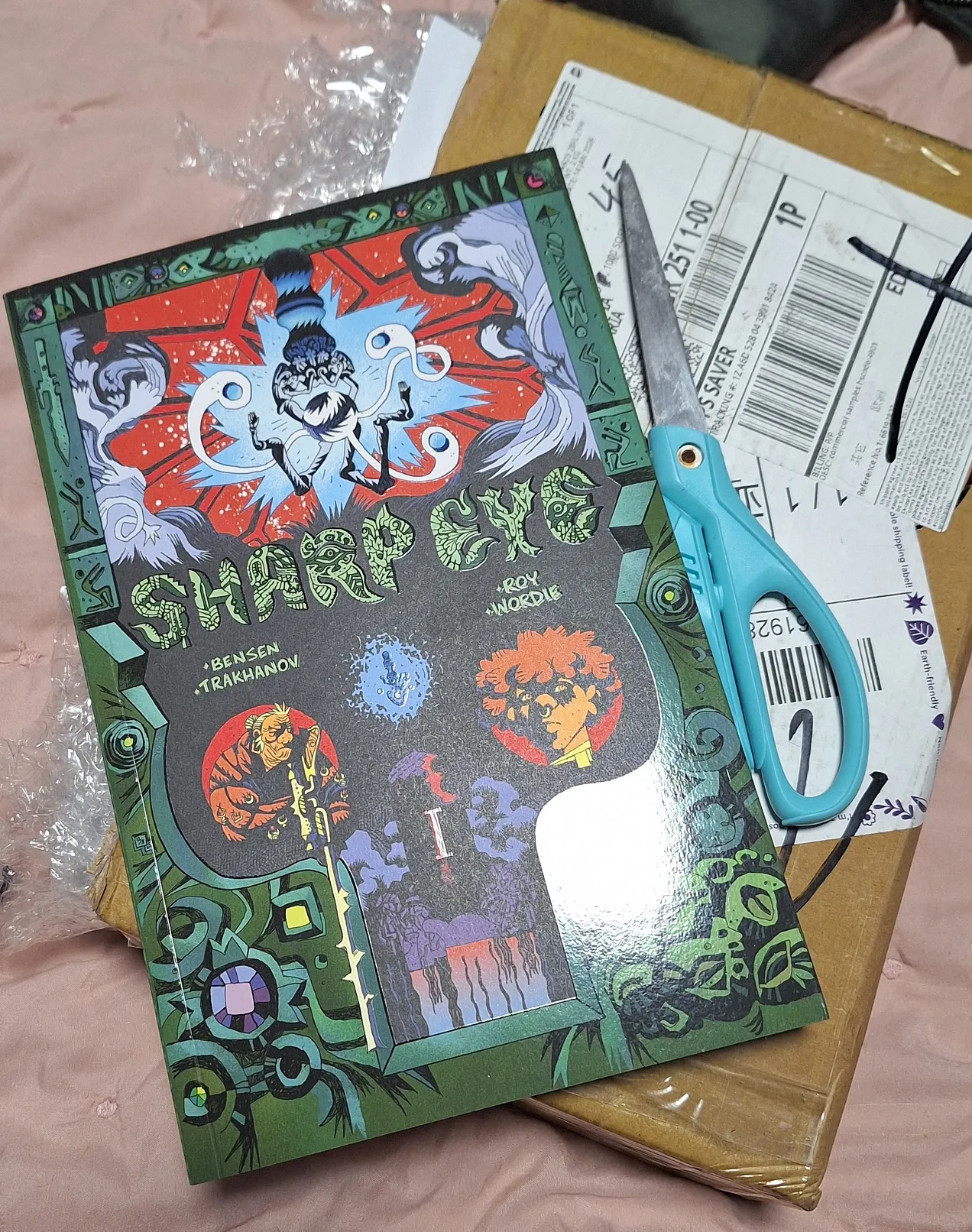
The shipment was ten copies of “Sharp Eye,” the comic I’d written and Kickstarted with Artyom Trakhanov, Simon Roy, and Jason Wordie, shipped to me by Tiger Press in Hong Kong. I’d been working on this project for five years, and now all that stood between me and my precious, glossy comics was this Customs official.
Reading their message now, I judge it to be wordy but straightforward enough. At the time, though, I was seized by a kind of hysterical blindness. What was this? Clear my what? Necessary why? I was totally at a loss, so I opened trusty old ChatGPT and began this fable of triumph and error.
Now, for some context, let me take you back to my Christmas vacation, that soft, glowing lull between Christmas and New Year’s, when you have no gifts to buy or geese to roast, and the prospect of entertaining guests until 1 a.m. is still several days away.1
We were in Belchin, a spa-hotel where the kids swam, Pavlina got massages, and I worked out and played with AI Projects. I had this idea I could ask ChatGPT how to use ChatGPT more effectively, in a loop of recursive self-optimization that would birth a digital god and conquer the galaxy, just like you read about in millennial sci-fi novels and on Twitter.
Well, the galaxy is still safe. ChatGPT certainly told me something. I got these documents saying things like “You are Dan’s Financial Advisor. Identify the root bottleneck, avoid novelty hacks,” which, when uploaded and queried, gave excessively mediocre advice. The “Chef” Project suggested meals like “Asian stir-fry with beef and bell peppers” and the “Teaching Assistant” told me to assign “writing: short paragraph ‘My Most Impressive Travel Experience.’”
But then: a glimmer of utility. When I fed a scene from my novel-in-progress into the “Editor” Project, it told me, “exposition overload at peak emotional moment” and “Mess is not sharp.”
It makes sense that this Project would actually be helpful, because I’ve spent a lot of time thinking about writing. When I was building the Editor Project and the AI asked me for my opinions, it got them. I told it about sharpness of character, and it brought my own advice back to me when I needed it.
Over the course of January, I learned to treat the AI as a mental battery, which I did need. I had about nine hours every day before I turned into a zombie, but if I put some good ideas into the AI in the morning, I could get them back out at night. It would walk me toward a goal when I was too tired to think, even though ChatGPT was still fairly useless at deciding what to do in the first place. Maybe I should have told it to remind me of that last part.

A friend of mine learned this maxim from his flying instructor: “You fly the plane, the plane doesn’t fly you.” It’s a warning against instrument fixation—pilots staring at readouts instead of maintaining a clear intention.
When I got that text message, I should have drafted an email to Customs, then asked the AI if I’d forgotten anything. At the very least, I should have said, “My goal is to get these comic books delivered at minimum cost.” Instead, I just shoved the text into its chat window and asked, “what should I do?”
“Proceed methodically,” the instrumentation said. “What to do first (correct order): Step 1 - identify the order. Step 2 - decide clearance method. Recommended: let IN TIME/UPS handle it. Step 3 - send documents (do this next)” followed by which documents, exactly.
It was almost good advice. As handholding went, top-notch. But when the AI analyzed the invoice from the printers, it extracted an incorrect, much higher number than the value of the comics. A number that I unthinkingly pasted into the email I sent to the Customs officials.
Fortunately, I sometimes talk to human beings as well as machines. Artyom and Pavlina were both shocked when I told them that the VAT and handling fees for ten comic books came out to 250% of their value. To their credit, UPS was willing to be talked down from this insane number, but their handling fees still raised the total to 100% of the value of the comics, which is still remarkably eccentric.
So, as I often ask ChatGPT: what lessons can I extract from this experience? Suggested language to paste into Operating Protocols.md: if I’m asking it “what should I do?” I’m using the AI as a security blanket. Yes, sometimes I need to shut my eyes and pretend it isn’t me doing some scary, money-adjacent thing, but when it really isn’t me flying the plane, that’s a problem. I need a clear idea of where I’m going. Otherwise, the bottom of my empty wallet is very cold this time of year.
By the way, the comics are beautiful. You can still order them.