


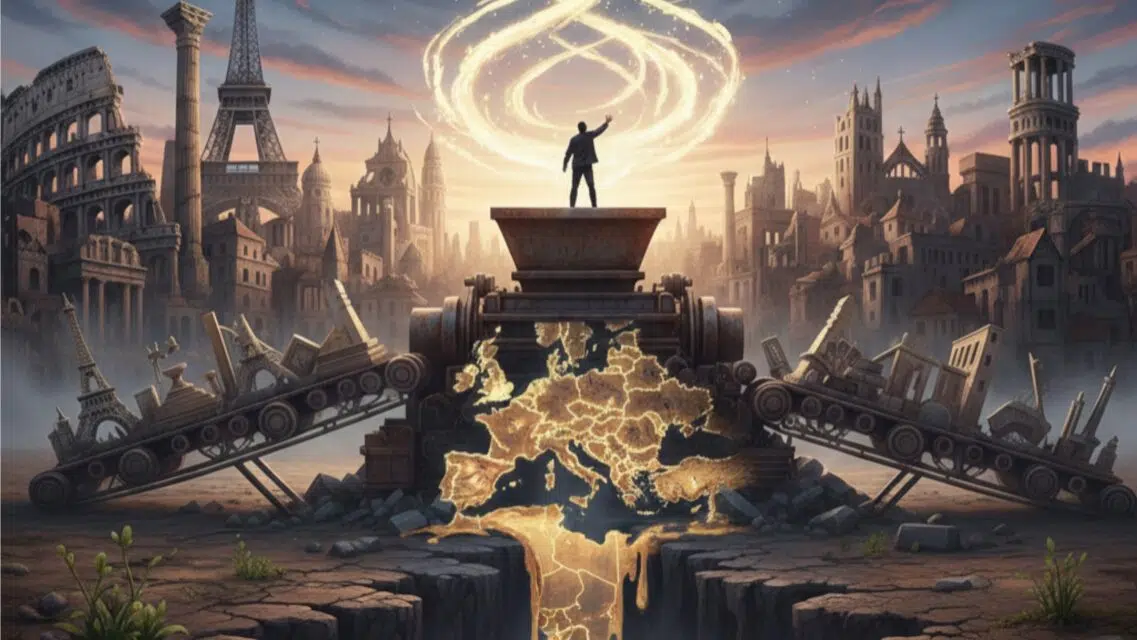
Europe is not collapsing. It is doing something more European than collapse: it is administering decline, competently, procedurally, and with a moral vocabulary that makes the slide feel like virtue.
In the last ten days, two elite mirrors reflected the same hard picture from different angles. Munich, the mirror of security, power, and war, ran its Security Conference from 13 to 15 February 2026, explicitly framed as the center of diplomacy while the continent argues about what security even means now. Davos, the mirror of money, energy, competitiveness, and narrative, convened under the theme "A Spirit of Dialogue" from 19 to 23 January 2026, and showed how much of Europe’s economic self-story has become a debate about whether the region can still afford its own ideals.
Europe’s crisis is not one problem. It is the way its institutions respond to all problems: by converting reality into process, until process becomes reality. The point of no return is not a single event. It is a threshold where incentives, demographics, energy, defense dependency, and institutional vetoes combine into a system that cannot change fast enough to survive its environment.
And yet the future is not uniformly bleak. The most plausible European renewal, strategic, economic, even civilizational, may be hidden in Eastern Europe, where history trained states to treat power as real, borders as meaningful, and time as scarce.
What follows is the argument: why Europe may have passed the point of no return, and why the next Europe may be built from the East. Not from outside the system, but from within it. Because that is how every serious transformation in history has actually begun: not by escaping broken institutions, but by forcing them to carry new weight.
Munich: Europe Wakes Up to a World Where America May Not Carry It
Munich this year was not a conference; it was an audit.
One data point says more than a thousand panels: Europe is debating "strategic autonomy" while simultaneously admitting it cannot guarantee its own security without the United States. The Financial Times summarized the new reality bluntly: Europe is preparing for reduced U.S. support and trying to build defense capacity fast, but EU leaders disagree on whether this is an EU project or a NATO project, and they disagree for structural reasons, not rhetorical ones.
Meanwhile, the Franco-German axis, always Europe’s political engine and always its political brake, looks increasingly like a gearbox stripped of teeth. Germany is pressing France to raise defense spending, committing very large sums over multiple years, and even opening politically explosive conversations about France’s nuclear umbrella. This is not a budget dispute. It is a confession that the post-1991 European settlement is over.
Even American messaging is no longer the soothing soundtrack Europe grew up with. The U.S. secretary of state’s tone in Munich was essentially: reassurance can be a trap; Europe must not confuse civility with commitment.
So Munich’s meaning is not "Europe must spend more." Europe can spend more and still lose, if it spends as twenty-seven committees instead of one polity.
The deeper Munich message: Europe is late to a power transition it helped deny. A continent that once produced the rules of the world now lives inside rules made elsewhere, especially on technology, capital, energy, and hard security. And the longer it waits for someone else to restore the old order, the more its own order decays.
Davos: Europe’s Competitiveness Problem Is Becoming Structural, Not Cyclical
Davos ran under the theme "A Spirit of Dialogue," but the subtext was harsher: dialogue does not pay your energy bill; it does not secure your supply chains; and it does not deter Russia.
The sharpest moment came not from a panel but from the hallway arithmetic that every executive was running quietly: European industrial electricity prices are now two to three times higher than those in the United States, and roughly 40 percent above Chinese levels. That is not a tariff problem or a currency problem. It is a location problem. When the CEO of a German Mittelstand firm sits with his board and calculates the cost of running a plant in Saxony versus South Carolina, the spreadsheet does not care about European values. It cares about cents per kilowatt-hour. And the spreadsheet is winning.
A growing body of analysis confirms what those hallway conversations implied. Europe’s high industrial energy prices are no longer a short emergency but a structural competitiveness risk, a design problem embedded in the architecture of the energy transition itself. Industry voices are publicly warning that the EU’s competitiveness crisis has deepened, with Europe losing ground against the United States and China across infrastructure and innovation. An IMF working paper estimates the 2022 energy-price shock reduces euro-area potential output levels, relative to a counterfactual, well into the mid-2020s. Even institutions built to be diplomatic are running out of diplomatic ways to say it.
Davos conversations about energy have shifted toward security and resilience, not just climate ambition. Analysts tracking the 2026 forum highlighted energy security, nuclear interest, and competitiveness pressures as the dominant themes, not carbon targets, not green bonds, not net-zero timelines.
If Europe cannot run cheap power at scale, it cannot stay an industrial continent. If it cannot stay industrial, it cannot fund welfare promises at current levels. If it cannot fund welfare promises, its politics radicalize. If politics radicalize, collective action becomes harder, right when it is needed most.
That is the "process itself to oblivion" dynamic: the system tries to preserve every legacy commitment by spreading costs invisibly, through regulation, debt, and external dependence, until the bill arrives as strategic weakness. Not as a dramatic crash, but as a slow repricing of relevance. The factories do not explode; they file relocation paperwork. The talent does not rebel; it updates its LinkedIn location to Austin or Singapore. The budgets do not collapse; they quietly become shells, maintaining the appearance of solvency while the capacity underneath drains away, the way a riverbed looks the same long after the water has stopped flowing.
Five Locks That Keep Europe from Changing Fast Enough
If Europe’s crisis were merely about bad decisions, it would be fixable. Bad decisions can be reversed. What makes this different is that the crisis is structural: a set of interlocking constraints, locks, that reinforce each other, narrowing the corridor for reform with each passing year.
Lock 1: Demography Meets Entitlement Arithmetic
Europe’s aging profile is not new; what is new is the collision with slower growth and higher security needs. When societies age, they become cautious, risk-averse, and fiscally tight, exactly the opposite posture required for rapid strategic rearmament and industrial reinvestment.
The numbers are unforgiving. Germany’s old-age dependency ratio will reach roughly 55 percent by the mid-2030s, meaning barely two working-age adults for every retiree. Italy’s is worse. Spain’s is approaching the same trajectory. These are not projections that depend on contested assumptions; they are people who have already been born.
You can break this lock, but only with choices Europe hates: later retirement, lower benefits, higher taxes, or large-scale productivity growth. Europe prefers a fifth choice: delay. And delay is itself a choice, it just sends the invoice to the next generation, which will be smaller and angrier.
Lock 2: Energy Costs and the Deindustrialization Flywheel
High energy costs do not just hurt factories; they redirect investment away from Europe altogether. Once industrial ecosystems hollow out, you do not simply "reshore" them with speeches. Supply chains relocate, talent follows, and the tax base shrinks. The warning about high energy prices turning into a structural risk captures this concern: the situation becomes less crisis management and more structural design.
This is a flywheel, not a pendulum. A pendulum swings back. A flywheel accelerates in one direction: energy costs push out industry, which reduces demand, which weakens the political case for energy investment, which keeps costs high. BASF did not cut its Ludwigshafen operations by coincidence. It did so because the arithmetic stopped working. And BASF is not an outlier; it is a leading indicator. Breaking this cycle requires the kind of decisive, fast-moving industrial strategy that Europe’s institutions were explicitly designed to prevent.
Lock 3: Security Dependence Plus Political Fragmentation
Europe wants to be a "geopolitical actor," but it still argues about whether defense is EU-led or NATO-led, and those are not merely branding differences; they imply different procurement rules, command structures, and industrial winners.
Europe can survive disagreement. What it cannot survive is disagreement under time pressure. And the clock is not theoretical. Russia’s war in Ukraine is not a future scenario; it is a present fact. The American security guarantee is not a future uncertainty; its conditionality is already being negotiated in public. Europe is debating committee structures while its strategic environment deteriorates in real time.
Lock 4: Institutional Veto Culture
The EU’s greatest strength, consensus across diverse nations, becomes a crippling weakness when the environment turns hostile. The system is designed to prevent sudden change. But sudden change is what geopolitical competition demands.
Consider the simple mathematics: any meaningful defense procurement reform requires agreement across governments that disagree about threat levels, industrial policy, fiscal rules, and the role of the Commission. Any energy policy shift must navigate the interests of countries that export gas, countries that import it, countries committed to nuclear, and countries that have banned it. The result is not gridlock, Europe is too sophisticated for gridlock, but something worse: the appearance of motion without the reality of movement. White papers multiply. Summits produce communiqués. The architecture of action is built, but the building remains empty.
Lock 5: Moral Overreach Without Material Capacity
Europe increasingly defines itself by universalist values and regulatory leadership. That identity can be noble. It is also dangerous if it substitutes for material power.
When a continent tries to be the world’s conscience while outsourcing its security and losing its industrial edge, it becomes easy to ignore, and easier to coerce. The regulatory superpower narrative was convincing when Europe was the world’s largest market and the Americans were handling security for free. Neither condition holds reliably anymore. Values without power are wishes. And wishes, however eloquent, do not deter armies, secure supply chains, or keep factories from moving to Texas.
This is why the "point of no return" is plausible: once these locks reinforce each other, reform becomes politically impossible even when it is intellectually obvious. Each lock makes the others harder to pick. Aging populations resist defense spending. High energy costs shrink the tax base that could fund defense. Security fragmentation prevents the coordinated energy policy that could lower costs. Institutional vetoes prevent the speed that could break any of these cycles. And the moral vocabulary that Europe uses to describe itself makes every hard trade-off feel like a betrayal of identity rather than a necessary adaptation.
Why Europe’s Future May Be Hidden in Eastern Europe
The most interesting thing about Eastern Europe is not that it is "more conservative" or "more nationalist." It is that its strategic culture is less theatrical. States like Poland, the Baltics, the Czech Republic, and Romania did not learn geopolitics from textbooks or think tanks. They learned it from occupation, partition, and the lived experience of what happens when great powers treat your sovereignty as negotiable.
That is not nostalgia. It is pattern recognition.
The Urgency Is Not Rhetorical, It Is Geographic
Munich’s atmosphere, Russia, war endurance, U.S. unpredictability, lands differently east of Vienna. For Poland, the war in Ukraine is not a policy problem; it is a border problem. For Estonia, Latvia, and Lithuania, Russian aggression is not a scenario in a defense white paper; it is the reason their grandparents were deported.
That proximity translates into political permission to do hard things. Poland has pushed its defense spending above 4 percent of GDP, the highest ratio in NATO, not because alliance politics demanded it but because Polish voters remember what undefended borders cost. The Baltic states have built serious cyber defense infrastructure and host NATO battle groups not as a diplomatic gesture but as an insurance policy purchased with clear eyes. Romania is investing in energy diversification, including a deal with NuScale for small modular reactors at its Cernavodă site, not out of ideological commitment but because it watched what energy dependence on Russia did to every country that trusted Gazprom’s handshake.
This is not bluster. These are countries making expensive, politically difficult choices right now, not scheduling reviews to discuss the possibility of convening a panel to consider future options.
The Frontier of Sovereignty
The EU’s central paradox is that it weakened sovereignty internally while relying on American sovereignty externally. For decades, this worked: the internal market replaced national industrial policy, and NATO replaced national defense. But the external guarantee is weakening, and the internal structure was never designed to compensate.
Eastern Europe, especially the states that entered the EU after the Cold War, often sees sovereignty not as nostalgia but as insurance. They joined the EU not to dissolve their national identity but to strengthen it through alliance. The difference matters. For much of Western Europe, sovereignty is a problem to be managed, a relic of the nationalist past. For much of the East, sovereignty is the thing that was taken away and had to be fought back, and the EU was supposed to guarantee it, not dilute it.
The next EU that works may be one that relearns sovereignty as capability, then cooperates from strength rather than from guilt.
A Different Growth Instinct
Poland’s GDP has roughly doubled in real terms since EU accession in 2004. In the same period, Italy’s has essentially flatlined. The Czech Republic has built a defense and precision engineering export sector, anchored by firms like Aero Vodochody and Czech Weapons International, that punches well above the country’s weight class. Romania is emerging as a nearshoring destination for European manufacturers who need lower costs but do not want to leave the EU regulatory perimeter, with Dacia’s parent Renault now running one of its most profitable operations from Mioveni. The Baltic states have become disproportionately important in cybersecurity, digital governance, and fintech: Estonia’s e-residency program and Wise’s Tallinn headquarters are not accidents but products of a small state that decided digital infrastructure was a survival strategy.
These are not charity cases. These are economies running on a growth instinct that much of Western Europe has lost: the conviction that you build your way up rather than regulate your way to safety. Western Europe increasingly operates on preservation logic, defending legacy arrangements, managing risk, distributing decline politely. Parts of Eastern Europe still operate on construction logic, building, digitizing, attracting investment, moving up the value chain, and doing it fast because history has taught them that windows close.
A Less Tired Europeanism
Western European elites often sound fatigued: defending the European project feels like defending a museum. The language is defensive, "preserving our values," "protecting our way of life," "safeguarding the acquis." It is the vocabulary of curators, not builders.
In parts of the East, Europe still feels like a project, something to construct, not merely inherit. This is not because Eastern Europeans are naïve about the EU’s flaws. They see the flaws clearly, often more clearly than their Western colleagues, because they came to the EU with fewer illusions and more at stake. But they also see the project as worth fighting over precisely because it is not finished.
Civilizations do not die only from external attack; they die when their best people stop believing renewal is possible. That sentence is not poetry, it is a diagnosis. When the most talented engineers in Germany weigh offers from Munich against offers from Austin and choose Austin, not for the weather but for the funding velocity; when French strategists write books about decline with the elegance of men composing their own epitaphs; when Brussels officials treat every reform proposal as a threat to institutional balance rather than a response to a world on fire, that is the symptom. The organism has not been killed. It has stopped fighting to live.
Eastern Europe has not stopped fighting. Not because it is more virtuous, but because it cannot afford to.
The Objection, and Why It Strengthens the Argument
The obvious objection is this: if Europe’s problem is institutional paralysis and veto culture, then Eastern European energy changes nothing, because these states operate inside the same broken structures. They sit in the same Council meetings, navigate the same Commission directives, face the same qualified majority thresholds. How can renewal come from within a system designed to prevent rapid change?
The objection is reasonable. It is also historically illiterate.
The Dutch Republic did not escape the Habsburg system to build a commercial civilization; it transformed from within the contradictions of that system, exploiting the very fragmentation that was supposed to keep it weak. The provinces that became the most dynamic trading network in seventeenth-century Europe were, on paper, still operating under imperial structures that should have strangled them. They succeeded not despite the system but through it, by moving faster and more purposefully than the system could constrain. Meiji Japan did not import reform from outside; a faction within the feudal order, using the old structures, titles, and even the emperor himself, dismantled the ancien régime from the inside. The samurai who abolished the samurai class did so wearing their own swords. The Marshall Plan did not work because postwar European governments were competent; most were fractured, exhausted, and politically unstable. France went through twenty-six governments between 1946 and 1958. It worked because external pressure met internal willingness in specific places, and those places dragged the rest forward.
Closer to home: the European single market itself was not built by unanimous enthusiasm. It was driven by a handful of committed states and a Commission president, Jacques Delors, who exploited institutional cracks that were supposed to be walls. The Schengen Agreement started with five countries, not twelve. The euro launched over British objection, Danish opt-outs, and widespread skepticism. Every major leap in European integration was achieved not because the institutions permitted it smoothly, but because determined actors forced new realities through old structures until the structures adapted or became irrelevant.
That is the pattern. Change does not arrive when systems are ready for it. Change arrives when a critical mass of actors inside the system decides that the cost of inaction exceeds the cost of friction. Eastern Europe is approaching that threshold faster than the West because its margin for error is smaller, its memory of catastrophe is fresher, and its leaders do not have the luxury of treating geopolitics as a seminar topic.
The EU will not be reformed from outside. There is no outside. It will be reformed, if it is reformed at all, by the members who need it most, pulling the institution toward reality the way a man overboard pulls a lifeboat: not gracefully, not politely, but with the full force of someone who understands that the alternative is drowning.
Europe Can Still Choose, But Not for Much Longer
The hardest version of the pessimistic case is not that Europe lacks assets. It is that Europe’s assets are irrelevant to its problem.
Europe has world-class engineers, deep capital markets, strong legal institutions, and genuine market scale. None of that is in dispute. What is in dispute is whether those assets can be mobilized under the current institutional and political constraints before the window closes.
The reform windows have largely shut. The best time to rearm was 2014, when Russia annexed Crimea and Europe held a concerned meeting. The best time to fix energy architecture was before the 2022 shock, when cheap Russian gas felt like strategy rather than dependency. The best time to modernize the growth model was before the productivity gap with the United States became chronic and self-reinforcing, before U.S. labor productivity growth outpaced the eurozone’s by nearly a full percentage point annually for a decade running. Now every necessary reform competes with every other necessary reform for the same scarce resources: money, political capital, and public patience.
The distributional fight is close to unwinnable. Every serious reform creates losers. In aging welfare states, losers vote, and they vote immediately. Winners are diffuse and emerge over decades. The political system therefore selects delay with mathematical reliability, not because politicians are cowards, but because the incentive structure rewards caution and punishes ambition.
Elite legitimacy is eroding from below. When publics feel poorer, less safe, and less heard, they do not merely change parties; they change the terms of debate. They stop asking which party will manage the EU better and start asking whether the EU should be managed at all. That erosion makes coherent multi-country strategy exponentially harder, because every government is now negotiating with its own populists as well as with twenty-six other capitals.
And the American anchor is no longer fixed. Whether the United States is "less supportive" or simply more conditional does not matter for the structural argument. Europe’s entire postwar model was built on the assumption of a stable American security guarantee. Munich made explicit what has been implicit for years: Europeans are now openly preparing for a weaker anchor, and they are doing so without a credible replacement.
If capital, high-end manufacturing, and frontier technology choose the United States or Asia, Europe can keep writing rules, just not the ones that matter. It can regulate artificial intelligence that is built elsewhere, tax profits that are earned elsewhere, and set standards for products that are manufactured elsewhere. It will be the world’s most eloquent bystander.
But here is what keeps the door from closing entirely: the very severity of the pressure is beginning to crack the complacency. Munich and Davos, for the first time in years, showed elites who sounded not just worried but structurally alarmed. Defense capacity is being discussed in previously taboo terms, including nuclear deterrence conversations and major spending commitments that would have been unthinkable five years ago. Energy and competitiveness are being reframed as strategic concerns, not merely market outcomes to be softened with subsidies. Industrial policy is back, pushed not only by politicians but by the industries themselves, who have grown tired of waiting for market theology to deliver results that only state coordination can produce.
But none of this works if Europe keeps trying to reconcile every value with every goal simultaneously. Strategy is choosing what you will not do. Europe has spent decades pretending that it never has to choose, that it can have open markets and industrial champions, green transition and cheap energy, defense autonomy and American protection, fiscal discipline and social generosity, all at once, forever. That pretense is the deepest source of the crisis, deeper than any single policy failure, because it makes every policy failure feel like an anomaly rather than a consequence.
A plausible renewal would look something like this: a hard security core anchored by the frontline states’ urgency, aligned with NATO reality while building EU-level industrial scale rather than EU-level rhetoric. An energy strategy that prizes affordability and resilience as much as decarbonization speed, and treats industrial electricity prices as a national security metric, not an afterthought. A competitiveness compact that simplifies permitting, accelerates infrastructure, and stops treating industrial capacity as morally suspicious. And a political culture that rediscovers the difference between values and strategy, not because values do not matter, but because values without capacity are liturgy, and the congregation is leaving.
Stop Mistaking Process for Power
If Europe wants one last chance to rethink itself, it must do the most un-European thing imaginable: act before consensus is complete.
Munich showed that the security environment is no longer forgiving. Davos showed that the economic environment is no longer patient. Together they show that the two pillars of European postwar identity, prosperity and safety, are both under structural threat at the same time, and that the institutional machinery designed to protect them has become the primary obstacle to their defense.
Europe has not yet fallen off a cliff. But it is nearing a point where it can no longer climb back up, because the institutions designed to prevent catastrophe also prevent adaptation. The five locks are tightening. The demographic arithmetic is worsening. The energy flywheel is accelerating. The security environment is deteriorating. And the political oxygen available for reform is being consumed by the very crises that reform was supposed to prevent.
The escape route is not a speech in Brussels. It is not another summit, another communiqué, another high-level working group on strategic competitiveness. It is a shift in political gravity: toward the part of Europe that still remembers that history punishes denial, that deterrence is cheaper than war, that industry is not an embarrassment, and that sovereignty without capability is a costume.
Systems do not reform themselves from comfort. They reform from the edges where denial is most expensive, where the gap between official narrative and lived reality becomes so wide that even institutional inertia cannot bridge it. Eastern Europe is that edge. Not because it has better ideas, but because it has less room to be wrong.
The Dutch did not wait for Habsburg permission to become a republic of commerce. The Meiji reformers did not wait for the shogunate to approve modernity. Delors did not wait for Britain to endorse the single market. In every case, the pressure came from within, imposed by people who understood that the cost of waiting exceeded the cost of acting imperfectly, and who trusted that a good enough decision made now would outperform a perfect decision made never.
Europe’s best chance is to rediscover that logic: not perfection, but movement; not consensus, but direction; not the elegance of process, but the rough, imperfect, urgent work of building power in a world that does not grade on intentions.
The continent that invented the modern world has not yet forgotten how. But it is running out of time to remember.