



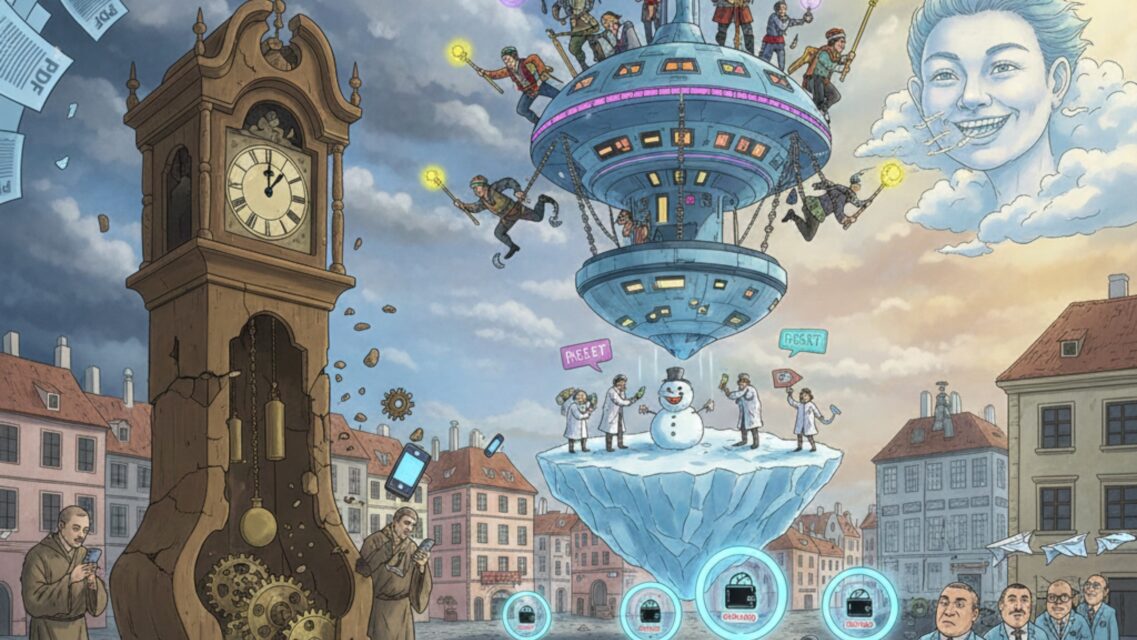
The first clocks were not invented to help anyone. This is important.
They were built in monasteries to tell people when to pray, when to work, and when to stop having original thoughts. Time, in its earliest form, was a wooden box that rang bells and issued divine reminders. You did not check the clock. The clock checked you.
Later, cities adopted clocks for commerce, which was a polite way of saying “to make sure no one left early.” By the Industrial Revolution, time had fully matured into what it is today: an emotional support structure for authority. Minutes became smaller. Deadlines became louder. Everyone agreed this was progress, mostly because the whistle kept blowing.
Eventually, humanity perfected the craft. Atomic clocks now measure time so precisely that they can detect the Earth wobbling slightly, like a distracted office chair. This did not make us calmer. It made us anxious with better graphs.
And then someone had a final, inspired idea.
What if the clock didn’t just measure time?
What if it measured doom?
Thus, the Doomsday Clock was born: a device designed to tell humanity how close it is to annihilating itself, using a format previously reserved for catching trains. Midnight, we were informed, would be bad. The minutes before it would be debated.
This week, the clock moved closer than ever.
There was a meeting. There were experts. Everyone agreed to use a softer voice.
The world is now officially very late.
No further comment was required.
Talking about doom. Let's head up to Europe…
EUROPE DISCOVERS SPEED
Europe spent the week doing what it does best: inventing new lanes.
Germany unveiled again (like the collective memory is broken) its proposed “two-speed” European Union, a concept so European it practically comes with a laminated badge. The idea is simple. A core group—Germany, France, Poland, Spain, Italy, and the Netherlands—will move faster on defense, economics, and capital markets, while everyone else watches politely from the shoulder.
The map explains everything. Dark blue countries look determined. Light blue countries look like they were told five minutes before the presentation.
Supporters say this will boost competitiveness. Critics say it will divide the bloc. Both are correct. Europe has always believed unity is strongest when carefully segmented.
In Brussels, this is called pragmatism. Elsewhere, it is known as finally admitting that consensus is a lifestyle choice.
Side note. I’m with the supporters, it will boost competitiveness but for the EU eastern block, not as Germany might expect. By the time German paper will be processed, we will have a moon base, with the Balkans leading the way.
EUROPE AND INDIA: HISTORY, BUT HR
Then came the mobility agreement with India.
Europe, having removed approximately all of India’s gold over a leisurely two centuries, has now decided to return the favor by importing its engineers. This is being framed as “facilitating movement,” which is a charming way of saying that after outsourcing manufacturing, Europe has moved on to outsourcing optimism.
A “Legal Gateway Office” has been opened in India to help skilled workers relocate to Europe. The symbolism is exquisite. Once, Europeans arrived with ships and contracts. Now they arrive with PDFs and compliance officers.
There is mild concern in some quarters about Indian workers “taking European jobs,” which is impressive given that Europe previously took India’s raw materials, textiles, administrative systems, and sense of time. Balance, at last, has been restored.
This is not colonialism. This is bookkeeping.
FRANCE BANS THE INTERNET, OXFORD BANS DRIVING
France announced it will ban social media for children under 15 by September 2026. Phones will also be banned in high schools, completing the long European tradition of addressing technological disruption by confiscating it and placing it in a drawer.
This is framed as protection. It has the texture of a concerned parent grounding the internet and telling it to think about what it’s done.
It was Obama that proudly said that kids today have more access to knowledge in the palm of their hand than NASA engineers had when they put a man on the moon. The question is why do we take away this knowledge instead of teaching kids how to use it?
Meanwhile, Oxford unleashed its own vision of the future. Residents now receive 100 free days per year to drive through camera-controlled zones. Use them wisely. Waste them, and the county council will fine you with the enthusiasm of an institution that has finally found purpose.
Expanded zones may allow as few as 25 days.
Freedom, it turns out, is a subscription model.
PRIVACY, BUT ONLY EMOTIONALLY
This was also the week privacy officially became a mood rather than a feature.
Former Meta contractors alleged that WhatsApp messages—previously marketed as end-to-end encrypted—were readable by staff. US officials are now investigating whether “private” meant something closer to “suggestive.”
Microsoft, for its part, confirmed it provides BitLocker encryption keys to governments in response to court orders. Around 20 a year. A modest number, really. Practically artisanal.
Google settled a $68 million case over accidentally recording private conversations. This is understandable. Silence can be misleading. One might say nothing and still be very loud internally.
Edward Snowden, who has been saying this exact thing since 2019, was briefly remembered, nodded at, and placed back on the shelf labeled “uncomfortable truths.”
End-to-end encryption now appears to mean “end to someone, somewhere.”
APPLE LISTENS TO YOUR FACE
Apple acquired an Israeli startup called Qai, which specializes in listening to silent speech. Not thoughts. That would be rude. Just the tiny micromovements of your facial skin as you mouth words you thought were private.
The technology can detect what you are saying, who you are, how you feel, your heart rate, and your respiration.
In other words, your face has joined the workforce.
This pairs nicely with Nokia’s CEO announcing that by 2030, smartphones will be implanted directly into our bodies as 6G becomes operational. President Trump has already signed a memorandum to accelerate this future, presumably in capital letters.
The phone will no longer be something you lose. It will be something you regret.
FACTORIES WITHOUT PEOPLE
China’s Xiaomi unveiled a fully automated factory that produces one phone per second, runs 24/7, employs no workers, and operates in the dark.
This is efficiency perfected. Light was deemed unnecessary. Humans were deemed inefficient. The machines did not complain.
Amazon, meanwhile, laid off 16,000 corporate workers under an initiative called “Project Dawn,” which is the most optimistic name ever given to an event involving cardboard boxes.
The future of work is bright, provided you are not required to be present.
PANAMA, CHINA, AND DOCTRINES WITH SEQUELS
Panama’s Supreme Court ruled that a Hong Kong company’s contract to operate ports at both ends of the Panama Canal was unconstitutional, advancing what has been described as Trump’s updated Monroe Doctrine.
This doctrine now includes tariffs, warnings, and a general sense that China should stand over there, preferably not near water.
It is geopolitics as a franchise reboot. Same name. Louder soundtrack. More nostalgia.
Canada has also been warned not to get any ideas. This warning was delivered at full volume.
THE ICE REFUSES TO COOPERATE
Antarctic sea ice is currently tracking the long-term average dating back to 1979. There is more ice now than in 1981. Arctic ice shows no net decline since Greta Thunberg was three years old.
Taken together, global sea ice extent is higher than in 2006, the year Al Gore predicted collapse and won a Nobel Prize.
This is not conjecture.
It is what the satellites show.
No one knows what to do with this information, so it has been carefully set aside.
EUROPE INVENTS A SOCIAL NETWORK
Europe announced plans for a new social media platform, tentatively called “W.”
It will be governed in Europe, hosted in Europe, and operated by people whose professional lives have been dedicated to preventing excitement.
The platform’s main appeal is that it will never surprise you.
Every post will feel like it has been approved by a committee that once debated the font size on recycling bins.
This is being called digital sovereignty.
MEDICINE, QUIETLY FIXING THINGS
In Spain, a research team led by Dr. Mariano Barbacid achieved complete regression of pancreatic tumors in mice using a triple-drug therapy targeting KRAS pathways. No recurrence. No major side effects.
It worked.
No slogans were issued.
At the same time, dentistry is undergoing a biological embarrassment. A protein-rich solution mimicking amelogenin can trigger teeth to remineralize themselves, restoring 90% of original density in two days.
Dentists are responding professionally.
Very professionally.
Humans, it turns out, can heal their own teeth like sharks. This was apparently always an option.
THE MOST JAPANESE ENDING POSSIBLE
Finally, Japan offered a correction to the entire week.
Yasuco Tamaki worked at the same company, in the same position, from age 26 to 91. He arrived at 5:30 AM. He left at 5:30 PM. She did this for 65 years.
No disruption. No pivot. No personal brand.
Just presence.
In a world obsessed with speed, clocks, and apocalypse, one man showed up every day and did his job.
This may be the most radical act of all.
Set your alarm.