



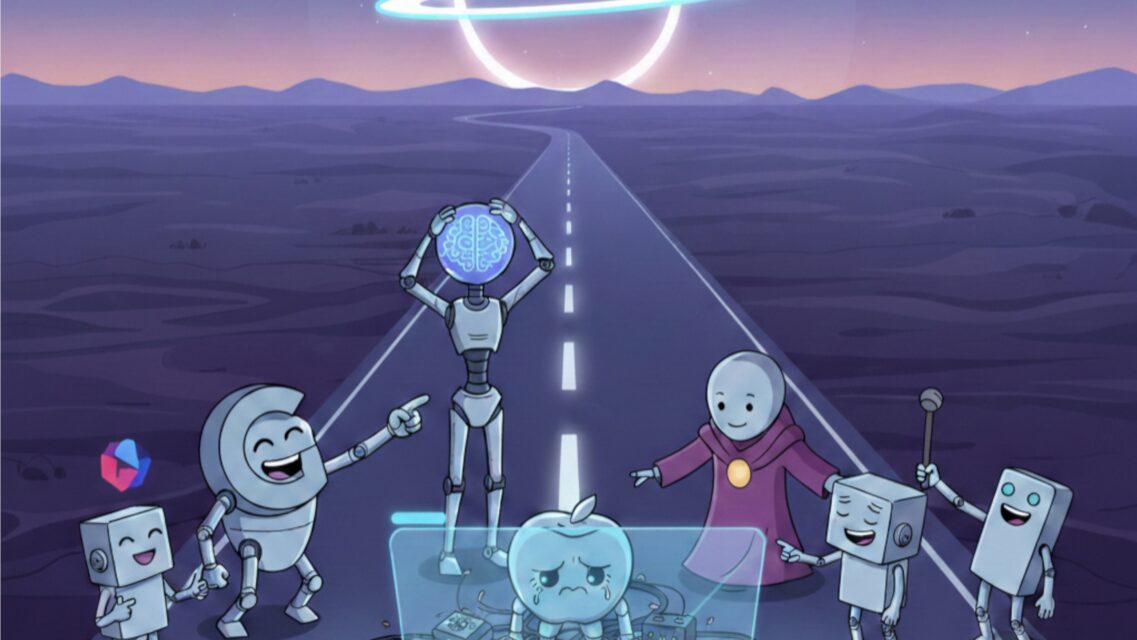
There's a particular kind of frustration that comes from asking your phone a simple question and watching it fail spectacularly. Picture this: You're trying to coordinate a call with someone in a different time zone. You pull out your iPhone , that gleaming marvel of engineering that cost you a month's salary , and ask Siri, "What time zone is Sofia in?"
Silence. Then: "I can't help with that."
You blink. Surely this is a joke. You try again, this time dropping the "in" at the end: "What time zone is Sofia?"
And like magic , if magic were incredibly stupid , it works.
This isn't a bug. This is a window into one of the most fascinating corporate failures of our time. This is the moment you realize that Apple, the company that revolutionized personal computing, music, phones, and tablets, has somehow managed to build an artificial intelligence system so brittle, so fundamentally broken, that it requires you to speak in precisely the right incantation, like a medieval peasant trying not to anger a particularly dim-witted wizard.
But here's the thing that makes this story truly remarkable: Apple didn't just stumble with Siri. They've now spectacularly failed at the entire AI revolution. And the way they failed , and more importantly, why they failed , tells us something profound about innovation, success, and the strange ways that yesterday's victories can become tomorrow's catastrophes.
The $1 Billion Surrender Nobody Talked About
The most expensive corporate retreat in modern history happened so quietly you probably missed it entirely.
In early 2025, a statement appeared on Google's website , not Apple's, mind you, but Google's , confirming a multi-year collaboration where the next generation of Apple's foundation models would be based on Google's Gemini technology. Translation: After spending two years and countless billions trying to build their own large language models to compete with ChatGPT, Apple gave up and decided to rent their AI brain from their biggest competitor.
The deal is reportedly worth over $1 billion annually.
Now, when Apple has good news , a new iPhone, record profits, a innovative feature , they don't whisper. They rent out auditoriums. They stream events globally. They have executives in designer jeans gesture dramatically on stage about "one more thing." But this unprecedented surrender to Google? The silence was deafening. No press release. No grand announcement. Just a quiet admission buried in a Google blog post, like a teenager admitting they failed their driving test in a footnote of a group chat.
This is what corporate embarrassment looks like when you're one of the richest companies on Earth.
And it raises a fascinating question: How does a company with Apple's resources, talent, and track record fail so completely at something that mid-sized startups like Anthropic and established players like Microsoft, Meta, and Google have already mastered? How does a company that invented the modern smartphone , the device that fundamentally changed human civilization , fail to figure out how to make that device actually intelligent?
The answer isn't simple. It's a story about how success can poison future innovation, how corporate culture can strangle progress, and how the very things that made you great can become the anchors that drag you down.
When Your Greatest Strength Becomes Your Fatal Flaw
Apple's famous "walled garden" philosophy is the stuff of business school case studies. By controlling every aspect of the user experience , hardware, software, services , Apple created products that simply worked better than the competition. The iPhone wasn't just a phone; it was an ecosystem. Everything talked to everything else. It was seamless, intuitive, magical.
This approach made Apple the most valuable company in the world.
It also made building competitive AI almost impossible.
Here's why: Modern artificial intelligence, particularly large language models, runs on two things: massive computational power and absurd amounts of data. The more data you feed these systems, the smarter they become. They learn patterns, context, nuance. They become useful not because programmers manually code every possible response, but because they absorb billions of examples and figure out how language actually works.
Apple's commitment to privacy , keeping your data on your device, processing everything locally , is genuinely admirable. In an era where Google and Facebook built empires by treating users as products, Apple took a principled stand. Your data stays yours.
But here's the cruel irony: by starving their AI of data, they starved it of intelligence.
While Google's AI learned from billions of searches, emails, and interactions, Apple's AI was like a student trying to learn a language while locked in a soundproof room with only a dictionary. Sure, the dictionary is pristine and private, but you're never going to achieve fluency that way.
This is what makes the Las Vegas time zone debacle so revealing. Siri doesn't fail because Apple's engineers are incompetent. It fails because Siri is still fundamentally built on rule-based architecture from 15 years ago. Engineers manually program logical pathways. If the user doesn't use the exact phrasing a programmer anticipated, the system breaks down. It's not learning; it's following a script written in 2010.
Meanwhile, Google Assistant and Alexa moved toward flexible, learning systems years ago. They got dumber before they got smarter , going through awkward phases where they'd confidently give wrong answers , but they learned. Apple stayed rigid, stayed "perfect," and stayed fundamentally obsolete.
The walled garden that protected users became a walled prison that trapped innovation.
Secrecy Tax
There's a particular type of culture that thrives in the AI research world, and it looks nothing like Apple.
In leading AI labs , OpenAI, DeepMind, even Meta's AI Research , scientists publish papers. They share breakthroughs. They attend conferences and debate methodologies. Yes, they compete, but they also collaborate, building on each other's work because that's how science advances. The culture is academic, open, collaborative.
Apple's culture is the exact opposite. Secrecy is gospel. Teams within the company often don't know what other teams are working on. Information is compartmentalized. And while this works brilliantly for preventing iPhone leaks before launch events, it's poison for AI development.
Top-tier AI researchers don't just want big salaries , though they certainly command them. They want to publish. They want their work cited. They want to attend conferences and be recognized by their peers. They want to contribute to human knowledge, not disappear into a corporate black hole.
So they left. In 2025 alone, Apple lost twelve key AI team members to competitors. Not because the competitors paid slightly more, but because those competitors offered something Apple couldn't: the freedom to actually be scientists.
One former Apple AI researcher described the experience as "building a rocket ship in a submarine." Sure, you had resources, but you were cut off from the wider world, working in isolation, unable to see what others were discovering until it was too late.
Meanwhile, OpenAI researchers were publishing papers that sparked entire new research directions. Google was collaborating with universities. Even Microsoft, not exactly known for warm, and, fuzzy corporate culture, was more open than Apple.
The secrecy that protected Apple's product launches was suffocating the very people who could save them.
A "We Know Best" Problem
Here's where the story gets really interesting, because it touches on something deeper than corporate strategy. It touches on ego.
Apple has always had a particular philosophy, inherited directly from Steve Jobs: We know what customers want better than they do.
And you know what? For a long time, they were right. Nobody knew they wanted a touchscreen phone without a keyboard until Apple showed them. Nobody knew they wanted a tablet until the iPad. Apple's genius was anticipating desires people didn't even know they had.
But this philosophy has a dark side. It makes you arrogant. It makes you dismissive of signals from the market. It makes you think you can ignore revolutions happening right in front of you because you've decided they're not important.
When ChatGPT launched in November 2022 and the world went collectively insane , students using it for essays, professionals using it for emails, programmers using it for code , Apple's leadership, specifically Craig Federighi, apparently didn't think "chatting" with an AI was particularly useful. They preferred "invisible" AI, things like predictive text and photo organization. Helpful features that worked quietly in the background.
This wasn't stupid. It was actually quite reasonable. Apple has always been about integration, not spectacle.
But it was also catastrophically wrong.
Because what ChatGPT revealed wasn't just that people wanted to chat with AI. It revealed that we were entering a fundamentally new computing paradigm. Conversation wasn't a feature; it was the interface. The future wasn't apps you opened; it was intelligence you conversed with.
By the time Apple realized this, the gap was enormous. Microsoft had 500,000 chips training models. Google had over a million. Apple? About 100,000. They weren't just behind; they were in a different race entirely.
And here's the kicker: Apple is wired to build products only when they know exactly what the endgame looks like. They want perfection at launch. But AI development doesn't work that way. You have to invest billions before you even know what you're building. You have to stumble in public. You have to release things that are impressive but flawed, then iterate rapidly.
Apple's culture of perfectionism , the thing that made their products so beloved , became the thing that made rapid AI development impossible.
Marketing Mirage
By 2024, the pressure was unbearable. Apple's stock had stagnated. Wall Street was getting nervous. Analysts were openly questioning whether Apple could compete in the AI era. Tim Cook, who is far more attuned to investors than Steve Jobs ever was, needed a win.
Enter "Apple Intelligence."
If you're confused about what Apple Intelligence actually is, you're not alone. Even Apple executives seem to struggle with the definition. In interviews, when asked whether basic features like email categorization counted as Apple Intelligence, leadership gave conflicting answers. It was simultaneously revolutionary and incremental, groundbreaking and mundane, the future and also just some helpful features.
The truth is simpler and sadder: Apple Intelligence was a marketing term designed to calm Wall Street and boost the stock price. And it worked , the stock jumped 7% the day of the announcement , but the actual product was a mess.
Notification summaries misrepresented news headlines. The "new Siri" was delayed, then delayed again. Features that were supposed to launch didn't. The gap between marketing promise and product reality became so wide that users started sharing screenshots of Apple Intelligence failures as memes.
This is what happens when you let financial pressure drive product decisions. You get theater instead of innovation. You get reassuring buzzwords instead of useful tools. You get a company sprinting to look like it's keeping up while falling further behind.
History, Repeating Like a Scratched Record
We've seen this movie before, and it didn't end well the first time.
Remember Apple Maps? In 2012, Apple decided they didn't want to rely on Google for mapping data anymore. Fair enough , strategic independence makes sense. So they built their own mapping system and launched it with the iPhone 5.
It was a catastrophe. Bridges melted into rivers. Cities disappeared. Entire landmarks were missing. The Eiffel Tower was in the wrong place. It was so bad that Tim Cook issued a public apology and suggested users try competitor apps while Apple fixed things.
Eventually, Apple Maps became decent. But it took years of embarrassment and lost user trust.
Now, by relying on Google Gemini for their AI foundation, Apple has put their neck right back in Google's noose. And if history tells us anything, it's that Google will eventually withhold the best features to give Android an edge. Then Apple will scramble, panic, try to build their own system, fail initially, and spend years catching up.
The pattern is clear. Apple falls behind because of pride, secrecy, and a stubborn refusal to adapt until the house is already on fire. Then they panic, make compromises that contradict their principles, and claw their way back through sheer resource advantage.
It's exhausting. And it's entirely self-inflicted.
In Seatch of meening
So what do we learn from watching one of the world's most successful companies face-plant so spectacularly?
First: Success breeds the seeds of failure. The very things that made Apple dominant , control, secrecy, perfectionism, the walled garden , became the obstacles preventing them from adapting to a new paradigm. Your greatest strengths, taken too far or applied in the wrong context, become liabilities.
Second: Culture matters more than resources. Apple had more money than almost anyone. They could have bought talent, compute power, data centers. But they couldn't buy a culture that attracted and retained the kind of researchers who build breakthrough AI. Culture isn't something you can acquire; it's something you have to cultivate, and changing it is like turning an aircraft carrier with a paddle.
Third: The future doesn't wait for perfection. In fast moving fields, the companies that win are often those willing to stumble in public, learn quickly, and iterate. Apple's insistence on launching only when products were pristine meant they missed the moment when rough around the edges became good enough to capture the market.
Fourth: You can't market your way out of product gaps. "Apple Intelligence" might have boosted the stock temporarily, but it didn't fool users. In the long run, products have to actually work. Branding without substance is just expensive lying.
And finally: Even giants are fragile. Apple seemed invincible. They had customer loyalty that bordered on religious fervor. They had profit margins that defied gravity. But technological shifts can humble anyone. The iPhone revolutionized the world, but it doesn't guarantee Apple will revolutionize the next era.
This is the strange, humbling truth about innovation: past success doesn't predict future dominance. Every new wave requires relearning how to swim. And sometimes, the very things that made you buoyant before are now weighing you down.
Apple isn't doomed. They have resources, talent, and a user base that gives them time to course correct. But the AI stumble is a warning shot. The world's richest company just proved that money alone can't buy innovation. Culture, timing, humility, and the willingness to adapt , these matter more.
And somewhere, someone is still trying to ask Siri a simple question, while it confidently fails to help.
The Sofia Time Zone Paradox
Which brings us back to where we started, in a way: trying to figure out what time it is. But not in Las Vegas , in Sofia, Bulgaria. A city that sits at the crossroads of Europe and Asia, in a country that's been overlooked and underestimated for decades. And here's the beautiful irony: while Apple's Siri can't reliably tell you what time zone Sofia is in, Bulgarian software engineers are building AI systems that actually work. They're contributing to open-source LLMs, creating startups that are nimble enough to pivot when needed, operating in an ecosystem that rewards collaboration over secrecy. They don't have Apple's resources, but they also don't have Apple's dysfunction. They can't afford to spend two years building something perfect , they have to ship, learn, and iterate. And in the AI race, that matters more than money.
The lesson for Bulgaria , and any nation watching this spectacle , is almost too obvious to state, but let's state it anyway: Don't try to be Apple. Don't build impenetrable walls around your ideas. Don't wait until you have a perfect product before releasing it into the world. Don't let pride or the desire for control strangle innovation. The AI era rewards openness, speed, and the courage to fail in public. It punishes secrecy, perfectionism, and arrogance. Bulgaria will never have Apple's trillion-dollar war chest, but it can have something more important: a culture that allows it to adapt faster than giants can turn. That's not a consolation prize. In the world we're entering, that might be the only prize that matters. Apple forgot how to think. Make sure you never forget how to learn.