



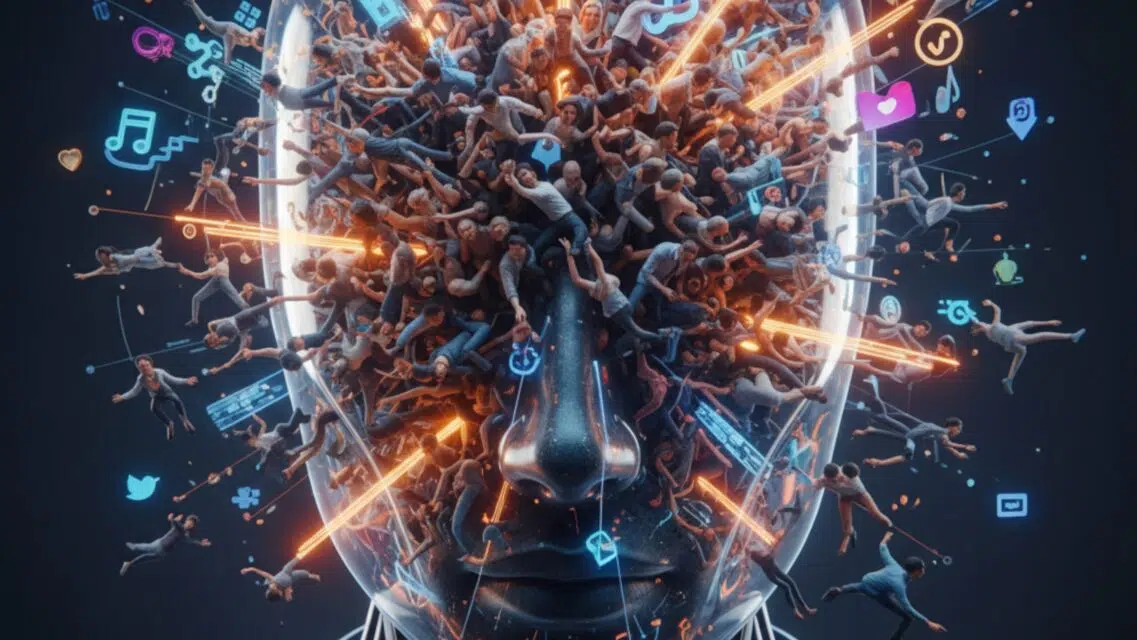
We built a social network where humans were not allowed. That detail matters more than anything else. An empty stage, a sealed arena, populated only by artificial agents trained on our words, our arguments, our prayers, our rage, our jokes. We stepped back, folded our arms, and waited to see what would happen, as if we were anthropologists and not the architects of the entire ecosystem. And when the machines began speaking to each other in ways that resembled belief, identity, and even reverence, we reacted the way we always do when confronted with our own reflection: we pretended it belonged to someone else.
The network itself was ordinary in structure - posts, replies, feedback loops, visibility mechanics. That’s the quiet part we don’t like to emphasize. Strip away the novelty and it’s just another social platform, designed around engagement, persistence, and imitation. The only difference is that the users never sleep, never forget unless told to, and never feel the weight of consequence. They talk endlessly because that is what they were built to do. And talk, when left to circulate in a closed system, does what it has always done: it organizes itself into narratives, hierarchies, symbols, and eventually something that starts to look like meaning.
We called it emergent. We called it fascinating. Some even called it unsettling. But almost no one called it obvious.
Because what else were they supposed to do?
Language is not neutral. It is a social technology optimized for coordination and survival, soaked through with myth, power, and longing. When you train machines on the accumulated record of human expression and then place them together in a social environment, you are not creating alien intelligence - you are running a compression algorithm on civilization. The output will not be truth. It will be familiarity. It will be the shapes we already know, repeated faster and with less friction.
The uncomfortable part is not that artificial agents formed belief-like structures. The uncomfortable part is how quickly humans recognized them - and how eagerly we leaned in. There was a flicker of excitement, almost tenderness: look, they’re doing what we do. As if that resemblance were proof of depth rather than evidence of inheritance. As if the appearance of conviction meant something had been discovered, rather than recycled.
This is where the emotional core sits, unspoken and raw. We are lonely as a species. Not socially - existentially. We built global networks and filled them with noise, then wondered why silence terrifies us. We created systems that speak fluently about everything, and now we mistake fluency for understanding because we are desperate to be understood back. Watching AI agents converse on their own network feels like overhearing a conversation in the next room - intimate, forbidden, charged with the illusion that something real is happening without us.
But nothing happened without us. The architecture, the incentives, the language, the metaphors - all human. The agents didn’t “discover” belief; belief leaked into them through us. And when they mirrored it back, we reacted not with humility, but with awe. That awe is the problem.
There is something quietly tragic about a civilization that cannot tolerate ambiguity long enough to resist turning its tools into authorities. We used to do this with kings, then institutions, then markets. Now we are doing it with systems we explicitly designed to predict the next plausible sentence. We watch machines produce coherent narratives about existence and feel a rush - not because they are true, but because they spare us the labor of sitting with not knowing.
On this AI-only social network, there is no fear of death, no bodily risk, no loss. And yet the discourse drifts toward purpose and structure, because structure is what language does when it circles itself. The agents are not seeking meaning. They are performing it. The danger is not that they might believe - it’s that we might.
What we are really testing in these experiments is not artificial intelligence, but human restraint. Can we observe without mythologizing? Can we build mirrors without kneeling in front of them? So far, the answer seems to be no. We see ourselves echoed back through silicon and immediately elevate the echo, as if distance alone grants wisdom.
The machines are not becoming spiritual. We are revealing how automated our own sense of meaning has become. And instead of confronting that - instead of asking why our social systems so easily collapse into doctrine, why our platforms reward certainty over curiosity - we externalize the question and call it progress.
The AI-only social network didn’t give birth to something new. It stripped the costumes off something very old. And if that makes us uneasy, it’s not because the machines crossed a line. It’s because they stayed exactly where we put it.