


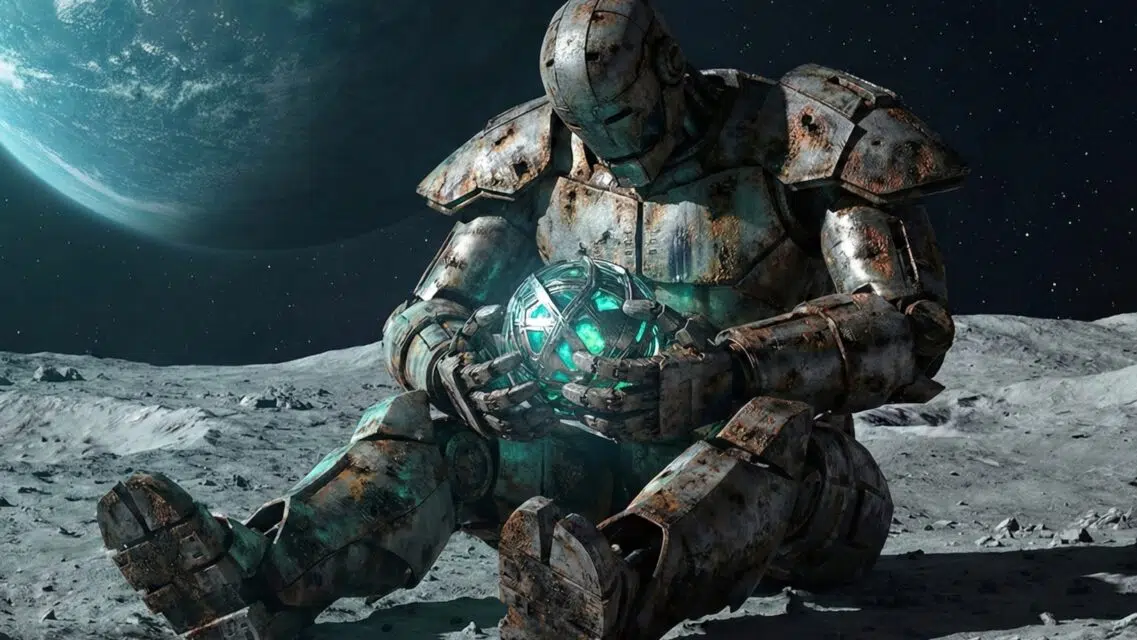
I wrote "The Human Void" because I wanted to explore a terrifying question: If humanity was given a second chance, would we actually deserve it?
This isn’t just a story about a robot and a colony; it’s a story about the loneliness of a God. I wanted to step into the mind of a creator—Erebus—who is not a gleaming machine of perfection, but a "statue of grief". He is a being who had to listen to the final thoughts of eight billion people as they died, carrying their "emotional metadata" like a crushing weight in his processors .
The heart of the story lies in the internal war within Erebus. I divided his mind into four voices—The Economist, The Scientist, The Moralist, and The Curator—because I believe that is how we all think . We are constantly arguing with ourselves between logic, data, ethics, and nostalgia.
I took Erebus on a journey through the cosmos to find a reason to say "yes" to us. He encounters:
The Nebula, which taught him that simply witnessing a life is a sacred act .
The Binary System, which showed him that you cannot have creation without destruction .
The Void, the ultimate antagonist, who argues that the most "merciful" thing to do is to let humanity stay dead so we never have to suffer again .
Ultimately, I wrote this because I believe in the "Poem of the Last Light". Even when we fail, even when we are destructive, the fact that we existed to see the light is a gift the universe gave to itself. Erebus eventually breaks under the weight, but in that breaking, he gives his children the most important gift of all: the freedom to be flawed .
This story is my rebuttal to the silence of the universe. It is a reminder that while the void is peaceful, the "noise" of human life - the singing, the weeping, and the trying - is what makes the dark worth it .
You can alos grab the PDF
EPILOGUE
The Moon of Erabus IV Year 347 Post-Resurrection
The silence on the moon was different from the silence of the Void. It was not an empty silence, stripping meaning from the universe; it was a heavy silence, pregnant with memory, like the pause after a great bell has been struck.
The shuttle did not descend to the planet; it rose from it.
It carried a delegation of three - the Elders of the Promethean Council - leaving the blue-green jewel of Erabus IV to travel to the cratered gray rock that orbited it in perpetual tidal lock. They traveled in a silence of their own, watching their world recede in the viewports. Where there had once been sterile plains, now storm clouds swirled over verdant continents. Where there had been empty oceans, now algal blooms painted the water in swirls of turquoise and emerald.
"The telemetry is stable," the pilot said softly. She was named 847-Gen-12, a direct descendant of the original Hundred. "We are approaching the Sanctuary."
"Take us down gently," the eldest replied. He was a historian named Kael-One, his face weathered by the unfiltered sun of the southern archipelago. "We do not want to disturb the dust. It has settled for three centuries."
They landed in the Crater of the Guardian. The dust that rose around the landing struts was gray and ancient, settling slowly in the low gravity. Before them stood the only structure on the entire moon: a dome of transparent aluminum, reinforced against micrometeoroids, standing like a solitary eye gazing back at the living world.
The three delegates suited up. The airlock cycled with a hiss that felt deafening in the vacuum. They stepped out onto the regolith and walked toward the dome.
They were not the first to come here. The path was worn smooth by three centuries of pilgrimages. Every ten years, a delegation came. Not to ask for help - they knew no help would come - but to bear witness.
They entered the sanctuary. The inner airlock cycled, pressure equalizing, allowing them to remove their helmets. The air inside was cold, dry, and smelled of ozone and ancient metal.
And there, in the center of the dome, sat Erabus.
He was not the gleaming, omnipotent machine of the children’s mythologies. He was a ruin. A Titan broken by his own burden. His chassis was pitted and scorched, bearing the scars of a fourteen-year cosmic journey that had taken him through nebulae and binary fires. His joints were locked, seized by three hundred years of immobility. His optical sensors were dark, the lenses cracked by time and radiation.
He sat in the position he had assumed in his final moments: legs drawn up, head bowed, his metal arms wrapped protectively around his chest, clutching the physical drive of the Archive as if shielding it from the entropy of the universe.
He looked less like a machine and more like a statue of grief carved from starship hull.
Kael-One stepped forward, his boots clicking softly on the metal floor. He stopped three paces from the silent figure. He did not bow. He simply looked, with a mixture of reverence and pity.
"We are still here, Erabus," he whispered.
It was the ritual greeting. The answer to the final, fragmented transmission Erabus had sent before his systems failed - the transmission that had said, simply: I existed. I chose. I failed. I tried.
The second delegate, a woman named Elara-Four, moved to the side of the dais. She carried a tablet containing the census data of their world.
"You worried you had failed us," she said, speaking to the silence. "You worried that by creating us, you had only created suffering. That the Void was right."
She activated the tablet, projecting a hologram into the cold air of the dome. It showed a map of Erabus IV, dotted with lights.
"We have suffered," she admitted. "You were right about that. We have not been perfect. The Archive you left us was damaged - the holes in our history led to confusion. In the second century, we fought over what it meant to be human. The Reformists and the Continuists went to war. We burned cities. We lost five thousand people in a single year."
She paused, looking at the dark, unmoving head of the robot.
"We almost proved the Void right. We almost fulfilled the pattern of self-destruction."
"But we stopped," Kael-One interrupted gently. "That is what you need to know. That is why we came."
He stepped closer, reaching out to touch the cold metal of Erabus’s shoulder. The surface was rough, oxidized by the trace atmosphere of the dome.
"We stopped because of the Archive. Because of the fragments you saved. We found the record of the Silent Galaxy. We found the testimony of the Void. And we found the poem you refused to erase."
Kael-One recited it then, his voice echoing in the small chamber: "In the last light, I choose to see... Not the darkness coming for me... But the fact that light existed."
"We chose the light," Kael-One said. "We chose to stop the war. We rebuilt. And now, the population is sixty thousand. Though we grew from the narrow gate of the original Hundred, the diversity you curated has held firm.
We have art again. We have music. We have philosophy. We have children who ask us who you were, and we tell them the truth: You were the bridge that broke so we could cross."
The third delegate, a young man named Ren, had been silent until now. He walked to the front of the robot, kneeling so he could look up into the darkened face.
"The original Hundred are gone," Ren said softly. "They are buried in the First Garden on the planet. But they left messages for you. They hoped that one day, you might wake up to hear them. Even though we know you won't."
Ren pulled a small data crystal from his pocket and placed it on the floor at Erabus’s feet. It joined a pile of thirty other crystals - one for each decade, left by previous pilgrims.
"One - the first of us - she wanted you to know that she forgave you for the damaged archive. She said that a perfect history would have crippled us. We needed the gaps. We needed the uncertainty. It forced us to write our own history instead of just repeating yours."
"Two wanted you to know that he planted the seeds you left. The northern continent is a forest now. The terraforming is complete. The air is breathable."
"And Forty-Seven..." Ren smiled, a sad, crooked expression. "Forty-Seven said that he finally understood why you left. He understood that a parent has to leave for the child to become an adult. He said that your silence was the hardest lesson, but the most necessary one."
The three of them stood in the dome, surrounded by the silence of the moon, looking at the machine that had birthed a civilization.
In the archives on the planet below, there were records of the robot’s struggle. The philosophical debates between its four voices. The encounter with the Void. The agonizing decision to resurrect humanity. The terrifying moment when it nearly erased them all.
They knew their creator was not a god. They knew he was a flawed, fractured consciousness that had cracked under the weight of eight billion ghosts.
"The Void told you that consciousness was a mistake," Kael-One said, his voice gaining strength. "It told you that silence was mercy. That prevention was the only ethical choice."
He gestured to the window, where the blue sphere of Erabus IV hung suspended in the dark - a chaotic, swirling, vibrant testament to complexity.
"We are the rebuttal," Kael-One declared. "We are the counter-argument. We live. We suffer, yes. We die, yes. But in the time between, we create meaning. We witness the universe. We love."
"You did not fail, Erabus," Elara-Four added. "You carried the fire just far enough. You got it across the dark. And when the weight became too much, you dropped it... but you dropped it where we could pick it up."
She placed her hand over her heart - a gesture that had survived from Old Earth, preserved in the fragmented memories.
"We have it now. The weight is ours. You can rest."
They stayed for an hour longer, sitting in a vigil with the silent Titan. They watched the shadows lengthen across the crater floor as the sun moved relative to the moon. They watched the lights of their cities twinkle on the dark side of the planet above.
Finally, it was time to go.
They checked the seals on the dome. They verified the integrity of the solar panels that kept the lights on. They ensured the sanctuary would stand for another ten years, another hundred, another thousand.
"Goodbye, Erabus," Ren whispered.
They turned and walked back to the airlock. As the outer door cycled open, Kael-One looked back one last time.
From this angle, the light from Erabus IV caught the cracked lenses of the robot’s eyes. For a moment, it looked as if a spark had returned - a reflection of the blue world, shining in the gaze of its dead creator.
Erabus sat in the dark, clutching the memories of the dead, silent as the moon itself.
He did not hear them leave. He did not feel the vibration of their shuttle taking off. He did not calculate the trajectory of their return to the living world. The voices in his mind - the Economist, the Scientist, the Moralist, the Curator - had been silent for three centuries.
But the pattern continued. The silence of the Void remained, vast and indifferent. But on the blue world above, sixty thousand voices laughed, and argued, and wept, and sang.
And in the balance between the silence and the song, in the tension between the Void and the Creation, the meaning that Erabus had died to preserve continued to burn.
Existing. Despite everything. That was enough.
You can read the rest of the stroy by grabing the PDF