



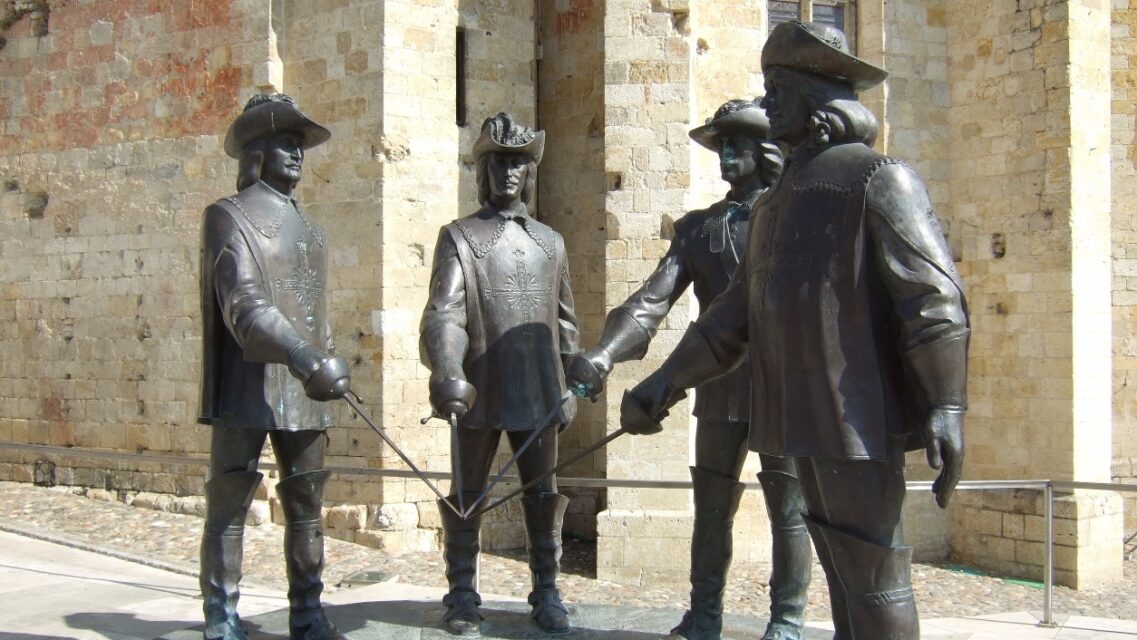
I came across a small journalistic footnote this week, the kind of item that appears briefly, generates no outrage, no think pieces, no panels, and then disappears into the algorithmic basement where unmonetizable reality is stored and quietly forgotten. It concerned the possible discovery of the remains of d'Artagnan, yes that d'Artagnan, under the floor of a church in Maastricht. More than three centuries after his death, one of the most durable figures of European myth may have been located not through grand design, but because a few tiles were broken and someone decided, without convening a working group, to look underneath.
This is already an unusual way for history to behave.
The skeleton was uncovered by a deacon, who noticed irregularities in the church floor and began, in what now reads like an act of procedural disobedience, to investigate. A wall was found, then soil, then eventually bone. At this point an archaeologist was called in, which is the modern signal that something has become official. The indicators were promising, burial under sacred ground, proximity to the altar, a coin from the correct period, and most helpfully, the bullet that had ended his life. One imagines this simplified the verification process. The past, when it chooses to be cooperative, can be quite efficient.
For over three hundred years, the assumption had existed. The stories had persisted. The burial had been rumored. But no one had actually checked. The floor remained intact, the narrative remained sufficient, and the system continued to function without the inconvenience of confirmation. It was only when the surface cracked that someone allowed reality to re-enter the room.
History, in other words, was not discovered. It was briefly permitted.
D'Artagnan himself exists in two forms, the first is administrative, the second literary. Administratively, he was Charles de Batz de Castelmore, a military officer, a servant of Louis XIV, a man embedded in the machinery of state power at a time when that machinery still had the decency to express itself physically. He carried orders, enforced decisions, and operated in an environment where mistakes were not filed, they were buried. Then there is the other version, the one that survived, the companion of Athos, Porthos, and Aramis, a figure of loyalty, risk, and movement, immortalized not because he managed anything, but because he acted.
Between those two versions sits the detail that should be slightly uncomfortable. He died in Maastricht, far from the symbolic center he served, and remained there, under a foreign church, for centuries, waiting to be rediscovered by accident. A man of precision, attached to one of the most centralized systems in European history, misplaced at the end by geography, circumstance, and time. Not a failure exactly, but a reminder that even highly organized systems occasionally lose track of their own conclusions.
It raises a mildly impolite question. Not whether he was brave, that part is well established, but whether the system he served understood where it was sending him. Or more precisely, whether it understood the difference between the mission and the movement required to complete it. It is possible to be entirely correct about purpose and still arrive in the wrong place. Institutions do this regularly. They call it alignment.
But the more interesting question is not about where he died, it is about what he represented while he was alive. The musketeer is one of those ideas Europe continues to display without entirely remembering how it functioned. Not just a soldier, not just a court appendage, but a person operating inside power who remained in contact with consequence. A man who did not merely interpret orders, but embodied them, with a proximity that made abstraction difficult and delay dangerous.
This is the part that has quietly gone missing.
The systems that produced men like d'Artagnan were not simpler, they were often brutal, inefficient, and occasionally catastrophic, but they retained one quality that modern institutional life has spent considerable effort removing. They allowed reality to reach decision-making without passing through layers of interpretation, translation, and procedural insulation. When something needed to be done, someone moved toward it, not after consultation, not after alignment, not after a framework had been circulated and lightly amended, but because the distance between decision and action was still measurable in steps rather than documents.
Europe still tells the story. It celebrates the loyalty, the courage, the romance of decisive action. It stages it, publishes it, teaches it, occasionally adapts it into something watchable. But it no longer recognizes the operating conditions that made it possible. The modern European instinct is not to move toward the problem, but to surround it with language until it becomes manageable, or at least formally acknowledged.
This is not cowardice. It is something more structured.
A civilization can become so proficient at organizing itself, so skilled at building layers between intention and outcome, that action begins to feel primitive, almost impolite. Directness becomes suspicious. Simplicity becomes unserious. The person who moves without first validating the movement appears not courageous, but unaligned. The musketeer, dropped into this environment, would not be admired. He would be escalated.
And this is where the story stops being historical and becomes diagnostic.
Because the question is no longer whether Europe remembers its past, it clearly does, the monuments are intact, the narratives are well maintained, the symbolic capital is considerable. The question is whether it still understands the difference between a system that acts and a system that describes action with increasing precision while waiting for something else to do it.
D'Artagnan did not operate inside a framework for coordinated response. He operated inside a reality that did not pause while he considered it. That is the difference. One demands movement. The other permits interpretation.
We have chosen interpretation.
And we are very good at it.
France, having already supplied the opening scene with a man who solved problems by moving toward them, now returns to offer a clarification. Not on action. On speech.
Brigitte Macron, speaking with the calm authority of someone standing inside one of the most linguistically engineered states on earth, explained that free speech, while admirable, requires limits. Liberty, she noted, must adapt to certain codes. One can almost hear the sentence being gently upholstered as it leaves the room, its sharper edges sanded down, its implications wrapped in something soft, agreeable, and administratively reusable.
This is, in its way, a remarkable civilizational update.
A country that once treated speech as sufficiently dangerous to justify decapitation now treats it as a system requiring moderation guidelines. The French Revolution did not, as it turns out, eliminate constraints on expression. It simply replaced the blade with a framework. The outcome is less dramatic, more sustainable, and significantly easier to document.
The underlying idea is not new. Speech has always had consequences. Words can provoke, destabilize, organize, destroy. Entire regimes have risen and fallen on the careful or careless deployment of language. But what is new is the tone in which this is discussed, the quiet managerial confidence that freedom is not something to be exercised, but something to be configured.
Liberty, in this formulation, begins to resemble a platform.
You are free, certainly. Within parameters. Within codes. Within a structure designed to ensure that expression remains aligned with acceptable outcomes, as defined by people who are themselves very careful with their words. It is not censorship, which is an ugly, historical term with unfortunate associations. It is calibration. Adjustment. A light touch applied repeatedly until deviation becomes statistically unlikely.
The revolution, in other words, has been refactored.
Where once there was a crowd, now there is a committee. Where once there was a moment of irreversible decision, now there is an ongoing process of refinement. The energy has not disappeared. It has been redistributed into language, into statements, into the careful construction of sentences that mean exactly what they are supposed to mean and nothing that might require apology later.
And yet, something has shifted in the relationship between speech and reality.
The men who argued in the cafés before 1789 were not discussing codes. They were discussing conditions. Bread, power, debt, authority, the small inconvenience of being governed by a system that had lost contact with the people inside it. Their language was not optimized. It was dangerous, imprecise, occasionally catastrophic. But it was connected, directly, to the world they were trying to change.
Modern speech, by contrast, often arrives pre-adjusted.
It anticipates reaction. It incorporates objection. It aligns itself with acceptable interpretation before it has even been delivered. It is less a tool for engaging reality and more a mechanism for ensuring that engagement remains within approved boundaries. One does not speak in order to collide with the world. One speaks in order to remain legible within it.
This is what it means to say that liberty must adapt to codes.
It is not a threat. It is a description.
And like most descriptions produced inside large, well-functioning systems, it is both reasonable and slightly alarming. Because once freedom is understood as something that requires continuous formatting, it becomes difficult to distinguish between expression and compliance. The line does not disappear. It softens. It becomes a matter of degree, of tone, of emphasis, of whether the sentence lands correctly within the broader architecture of acceptable speech.
The guillotine, for all its brutality, had the advantage of clarity.
It was decisive. It did not require interpretation. It did not produce guidance notes. It did not circulate drafts. It simply ended the discussion in a way that left no ambiguity about the consequences of saying the wrong thing at the wrong time.
Modern systems prefer ambiguity. They scale better.
They allow for correction, for iteration, for the gradual alignment of language with expectation. They do not silence speech. They shape it. They encourage it to move in certain directions, to avoid others, to become, over time, less a reflection of thought and more a reflection of structure.
This is presented, quite sincerely, as progress.
And in many ways, it is. Fewer heads roll. Fewer catastrophes unfold in the space between a sentence and its reception. The system becomes more stable, more predictable, more capable of managing itself without resorting to spectacle.
But stability has a cost.
When speech is continuously adapted to fit codes, it begins to lose its ability to surprise, to disrupt, to force a confrontation with something that cannot be easily absorbed into the existing framework. It becomes safe, and in becoming safe, it becomes less useful as a tool for navigating a world that is not, in any meaningful sense, safe.
This is where the distance begins to open.
Between what is said and what is happening. Between the language used to describe reality and the reality itself. The system continues to speak, fluently, coherently, with impeccable tone. But the connection weakens. Not dramatically. Not enough to trigger alarm. Just enough that, over time, the words begin to feel like they are describing something adjacent to the world rather than the world itself.
France, of all places, understands the power of language.
It has seen what happens when words escape control, when they ignite, when they refuse to remain within the boundaries assigned to them. It has built an entire modern state in part to ensure that this does not happen again in quite the same way.
And now, having achieved that stability, it offers a small, reasonable suggestion.
Be free.
But do so correctly.
France, having just explained that liberty must adapt itself to codes, then moved with admirable efficiency to demonstrate how the modern European state now handles hard power, namely by attaching it to consumer software and hoping nobody notices. The aircraft carrier Charles de Gaulle, a piece of military hardware intended to project sovereignty, deter adversaries, and generally embody the still faintly maintained fiction that Europe can act in the world as something other than a multilingual consultancy with flags, was reportedly located by journalists through the Strava activity of an officer jogging on deck. Not hacked, not infiltrated, not betrayed in some operatic burst of espionage, but gently disclosed by a fitness app designed to help professionals in expensive shoes feel better about intervals.
It is difficult to improve on this as a summary of the age. A nuclear-powered warship, named after a man who at least understood grandeur, reduced to a glowing breadcrumb trail because someone wanted credit for cardio. One half expects the next communiqué from Paris to explain that strategic autonomy remains fully intact, subject only to minor synchronization issues with wearable devices. France regulates language with the stale self-confidence of a civilization that still believes syntax is a form of sovereignty, while its officer corps appears to be outsourcing operational secrecy to the settings menu. This is not decadence in the old, enjoyable sense, all velvet and duels and expensive collapse. It is decadence in spreadsheet form. A republic of codes discovering that location sharing was on.
And once you notice that particular species of contradiction, the rest of Europe begins to arrange itself around it like damp around a pipe. In Sweden, a justice minister supportive of intrusions into other people's communications was asked whether journalists might inspect his own recent SMS messages, to which he replied no, for what he believed to be obvious private reasons. Quite right.
They are private.
The remarkable thing is not that he said it, but that he said it with the serene confidence of a man standing inside a system that has entirely ceased to notice its own shape. Privacy, it turns out, remains a sacred principle provided it is experienced from the correct side of the desk. For officials it is dignity, discretion, the necessary sealed compartment in which responsible people think responsible thoughts. For everyone else it is an obstacle, a regrettable patch of darkness in an otherwise well-lit architecture of supervision.
Meanwhile the political weather shifts, and suddenly the same class that spent years describing borders, deportations, sovereignty, and public order as vulgar obsessions of the unserious finds itself approving tougher migration rules with the grim efficiency of a man quietly reinstalling the front door after a decade spent insisting walls were a troubling metaphor. Elections across Europe begin returning results that the managerial center classifies first as alarming, then as regrettable, then as requiring serious reflection, which is its preferred phrase for the moment after reality has already entered the building and is standing in reception holding a baseball bat. France moves. Germany moves. Denmark moves. The language changes last, as always. Systems like this never pivot elegantly. They continue facing the wrong direction while their feet shuffle beneath them.
And beneath all of it, as ever, sits energy, that ancient enemy of sophisticated political self-description. The industrial world may be sliding toward another crisis driven by war in the Middle East, gas shortages, disrupted production, and the sort of material constraints that cannot be negotiated with declarations or moderated by tone. Germany now admits, with the mournful air of a man finding his own trousers in the freezer, that shutting down nuclear power was a huge mistake. Quite so. The country removed a dense, stable energy source in the name of managed virtue, discovered that factories prefer electricity to moral positioning, and now proposes gas as the only realistic bridge to stability, which is a beautiful sentence if one enjoys hearing an entire industrial strategy collapse into reluctant thermodynamics. Energy policy is where political abstraction goes to die. Molecules remain stubbornly unconvinced by values symposiums.
That is the part modern Europe struggles to say out loud. The problem is not merely censorship, or migration, or energy, or electoral panic, or strategic dependence, though it is of course all of those things in turn. The deeper problem is that the governing class has become so fluent in codes, frameworks, and managed interpretation that it no longer trusts unformatted contact with reality. Everything must be cushioned before it can be touched. Everything must be translated into policy language before it can be acted on. And so the continent lurches from one rediscovery of the obvious to the next, speech requires limits, war affects energy, borders matter, privacy is private, factories need power, adversaries read apps, while the rest of the world carries on with the faintly insulting energy of people who never mistook a framework for a shield.
America, by contrast, does not manage decline through language. It stages it.
Melania Trump recently appeared at an event accompanied by a humanoid robot. The machine stood, spoke, and performed just enough approximation of presence to trigger the familiar modern reaction, not awe, not fear, but a kind of distracted acceptance, as though the future had arrived slightly underdressed and was waiting to be told where to stand.
Europe writes frameworks for systems it cannot quite control. America invites the systems onto the stage and applauds. Neither understands what it is looking at. Both proceed anyway, because proceeding has become the default behavior of a civilization that has confused demonstration with direction.
And while the spectacle continues, the substrate shifts.
Warnings now circulate that a broader conflict in the Middle East risks triggering the worst industrial crisis in living memory, a phrase so heavy with consequence that it arrives pre-softened, wrapped in institutional tone, gently lowered into the discourse as if it might break something if dropped too quickly. Energy prices rise. Supply chains strain. Production tightens. The sort of dull, physical pressures that do not trend particularly well but have the unpleasant habit of determining what is actually possible.
The modern system has a peculiar relationship with this kind of reality. It acknowledges it, certainly. It issues statements. It prepares scenarios. It convenes. But it does so in a language that implies a degree of control that the underlying conditions do not recognize. Gas flows or it does not. Ships pass or they do not. Factories run or they do not. There is no annex to thermodynamics.
AI systems now generate other AI systems, not metaphorically, but operationally, spawning agents, distributing tasks, synthesizing outputs, completing work without waiting for approval or understanding. A new class of tool does not assist the user. It replaces the sequence. You give it an objective. It constructs the process. It returns the result. The human remains present in the diagram, but increasingly decorative, a kind of ceremonial origin point for a chain of events that no longer requires supervision once initiated.
This is not automation in the traditional sense.
It is autonomy with documentation lag.
Labor is reclassified, not explicitly, not with any formal declaration, but through behavior. Workers are removed. Compute is added. Output is maintained or improved. The market responds positively. The signal is clear, repeated, and increasingly difficult to misinterpret. Human contribution is valuable, up to the point at which it can be replaced. After that, it becomes an inefficiency.
This is described as transformation.
It is closer to substitution.
The organization, once a structure containing people, becomes a structure containing processes that require fewer people over time. Memory, experience, tacit knowledge, all the things that once justified continuity, are gradually externalized, encoded, or simply discarded. The system becomes lighter, faster, more responsive to capital, and less attached to the humans it nominally employs.
Which would still be manageable if competence scaled with complexity.
It does not.
At the point where systems become most intricate, the failures remain stubbornly basic. A platform leaks because the default setting was never changed. A warship broadcasts because the app was convenient. The machinery grows more sophisticated. The interface remains human.
And the human, despite everything, still clicks.
Somewhere at the edge of this, the boundary between real and synthetic begins to soften in ways that would have seemed excessive even a decade ago. People now pay others to simulate their presence at events they did not attend, photographs taken, angles chosen, proximity implied, a small theater of participation constructed entirely for the benefit of an audience that does not quite believe it but engages with it anyway. The internet, which began as a means of accessing reality more directly, now increasingly functions as a medium for manufacturing acceptable versions of it.
In China, a woman has built a small, efficient business out of this shift. Clients send her their profiles. She goes to concerts in their place. She positions herself near the stage, takes photographs from the correct angles, captures the right lighting, the right crowd density, the right proximity to relevance. The images are returned, uploaded, interpreted as experience.
The client was there.
The client was not there.
The system does not distinguish.
This is not quite deception. It is too organized for that. Too mutually understood. It is substitution, clean, transactional, and quietly scalable. Presence outsourced. Experience converted into evidence. Reality reduced to something that can be generated, delivered, and consumed without the inconvenience of participation.
In 1995, Sandra Bullock became the first person to buy a cinema ticket online. At the time, this was presented as progress, access improved, friction reduced, the removal of unnecessary physical constraints between intention and experience.
The ticket was never the innovation.
Attendance was.
And even that, increasingly, is optional.
A civilization that no longer trusts direct contact with the world does not collapse.
It adapts.
It builds layers. It refines representation. It improves the interface. Until eventually the concert happens, the photograph exists, the participation is recorded.
The floor remains intact.